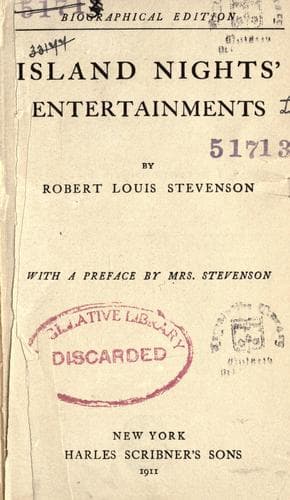
Island Nights' EntertainmentsStevenson, Robert Louis
General
Island Nights' Entertainments
Stevenson, Robert Louis
Islands of the Pacific -- Fiction; Short stories
They gave him gin and biscuit and dry clothes, and asked him how he
came where they found him, and whether the light which they had seen
was the lighthouse, Lae o Ka Laau. But Keola knew white men are like
children and only believe their own stories; so about himself he told
them what he pleased, and as for the light (which was Kalamake’s
lantern) he vowed he had seen none.
This ship was a schooner bound for Honolulu, and then to trade in the
low islands; and by a very good chance for Keola she had lost a man off
the bowsprit in a squall. It was no use talking. Keola durst not stay
in the Eight Islands. Word goes so quickly, and all men are so fond to
talk and carry news, that if he hid in the north end of Kauai or in the
south end of Kau, the wizard would have wind of it before a month, and
he must perish. So he did what seemed the most prudent, and shipped
sailor in the place of the man who had been drowned.
In some ways the ship was a good place. The food was extraordinarily
rich and plenty, with biscuits and salt beef every day, and pea-soup
and puddings made of flour and suet twice a week, so that Keola grew
fat. The captain also was a good man, and the crew no worse than other
whites. The trouble was the mate, who was the most difficult man to
please Keola had ever met with, and beat and cursed him daily, both for
what he did and what he did not. The blows that he dealt were very
sore, for he was strong; and the words he used were very unpalatable,
for Keola was come of a good family and accustomed to respect. And what
was the worst of all, whenever Keola found a chance to sleep, there was
the mate awake and stirring him up with a rope’s end. Keola saw it
would never do; and he made up his mind to run away.
They were about a month out from Honolulu when they made the land. It
was a fine starry night, the sea was smooth as well as the sky fair; it
blew a steady trade; and there was the island on their weather bow, a
ribbon of palm trees lying flat along the sea. The captain and the mate
looked at it with the night glass, and named the name of it, and talked
of it, beside the wheel where Keola was steering. It seemed it was an
isle where no traders came. By the captain’s way, it was an isle
besides where no man dwelt; but the mate thought otherwise.
“I don’t give a cent for the directory,” said he, “I’ve been past here
one night in the schooner _Eugenie_; it was just such a night as this;
they were fishing with torches, and the beach was thick with lights
like a town.”
“Well, well,” says the captain, “its steep-to, that’s the great point;
and there ain’t any outlying dangers by the chart, so we’ll just hug
the lee side of it. Keep her romping full, don’t I tell you!” he cried
to Keola, who was listening so hard that he forgot to steer.
And the mate cursed him, and swore that Kanaka was for no use in the
world, and if he got started after him with a belaying pin, it would be
a cold day for Keola.
Public-domain text, read in full here on John Shaqi.
Reviews
Reviews
No reviews yet
Be the first to share your thoughts on this work.
Elsewhere in the archive
Join the Discussion
Join the discussion
Sign in to leave a comment or review.
Sign InorCreate an account