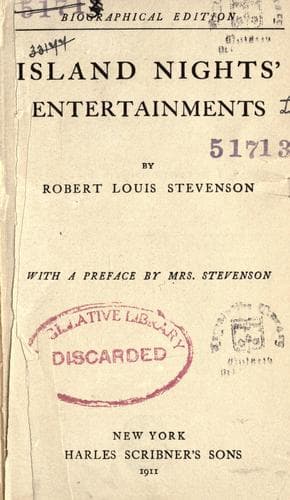
Island Nights' EntertainmentsStevenson, Robert Louis
General
Island Nights' Entertainments
Stevenson, Robert Louis
Islands of the Pacific -- Fiction; Short stories
Keola thought a good bit with himself. He saw he would be all right
when the tribe returned to the main island, and right enough where he
was, if he kept by the lagoon, yet he had a mind to make things righter
if he could. So he told the high chief he had once been in an isle that
was pestered the same way, and the folk had found a means to cure that
trouble.
“There was a tree growing in the bush there,” says he, “and it seems
these devils came to get the leaves of it. So the people of the isle
cut down the tree wherever it was found, and the devils came no more.”
They asked what kind of tree this was, and he showed them the tree of
which Kalamake burned the leaves. They found it hard to believe, yet
the idea tickled them. Night after night the old men debated it in
their councils, but the high chief (though he was a brave man) was
afraid of the matter, and reminded them daily of the chief who cast a
spear against the voices and was killed, and the thought of that
brought all to a stand again.
Though he could not yet bring about the destruction of the trees, Keola
was well enough pleased, and began to look about him and take pleasure
in his days; and, among other things, he was the kinder to his wife, so
that the girl began to love him greatly. One day he came to the hut,
and she lay on the ground lamenting.
“Why,” said Keola, “what is wrong with you now?”
She declared it was nothing.
The same night she woke him. The lamp burned very low, but he saw by
her face she was in sorrow.
“Keola,” she said, “put your ear to my mouth that I may whisper, for no
one must hear us. Two days before the boats begin to be got ready, go
you to the sea-side of the isle and lie in a thicket. We shall choose
that place before-hand, you and I; and hide food; and every night I
shall come near by there singing. So when a night comes and you do not
hear me, you shall know we are clean gone out of the island, and you
may come forth again in safety.”
The soul of Keola died within him.
“What is this?” he cried. “I cannot live among devils. I will not be
left behind upon this isle. I am dying to leave it.”
“You will never leave it alive, my poor Keola,” said the girl; “for to
tell you the truth, my people are eaters of men; but this they keep
secret. And the reason they will kill you before we leave is because in
our island ships come, and Donat-Kimaran comes and talks for the
French, and there is a white trader there in a house with a verandah,
and a catechist. Oh, that is a fine place indeed! The trader has
barrels filled with flour, and a French warship once came in the lagoon
and gave everybody wine and biscuit. Ah, my poor Keola, I wish I could
take you there, for great is my love to you, and it is the finest place
in the seas except Papeete.”
Public-domain text, read in full here on John Shaqi.
Reviews
Reviews
No reviews yet
Be the first to share your thoughts on this work.
Elsewhere in the archive
Join the Discussion
Join the discussion
Sign in to leave a comment or review.
Sign InorCreate an account