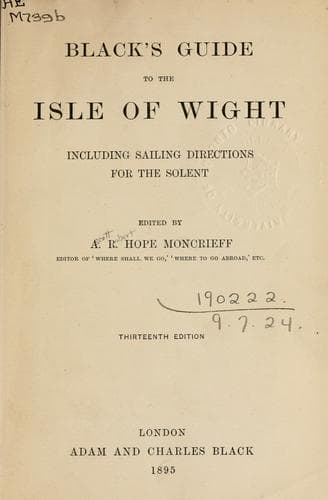
Isle of WightMoncrieff, A. R. Hope (Ascott Robert Hope)
History
Isle of Wight
Moncrieff, A. R. Hope (Ascott Robert Hope)
Isle of Wight (England) -- Description and travel
other admirably; and their whole appearance, though almost beyond
the reach of art to imitate, was extremely pleasing to the eye.
Their forms, divested of colour, when viewed near, and from the
beach, were often of the most sublime class; resembling the
weather-worn peaks of Alpine heights. This circumstance they derive
from the same source as those primitive mountains; for the strata
being vertical, the rains and snow water enter between them, and
wear deep channels, leaving the more solid parts sharp and pointed.
The alum that gives the name to this bay, oozing from its motley face,
seems no longer of commercial account; but the pure white sand is used
in glass-making, and the coloured sands are arranged in fantastic
patterns to make curiosities or memorials for the excursionists who
flock to this spot by coach, by steamer from Bournemouth and other
seaside towns, or by an hour’s walk from Freshwater station. For their
entertainment, there are two hostelries and some humbler refreshment
rooms; but as yet Alum Bay has not been turned into a bathing-place,
though round its northern corner rises one of the favourite summer
resorts of the Island.
Another contrast appears from the hollow behind the bay. The chalk downs
on one side are smooth, as if shaved by their own razor-like edges; on
the other, Headon Hill swells up in moorland knolls and banks of
heather, its rough sides clothed with tufts of yellow flowerets and
ragged grass. Headon Warren is a fitting _alias_. From its blunt head,
some 400 feet, we look down upon the lower and darker cliffs of the
inner coast, studded with brick forts that would be an ugly sight to an
enemy seeking to force the passage of the Solent.
We have done now with wonders, but the north-western face of the Island
makes a pleasant shore line, on which, in a mile or so, is reached the
snug beach of Totland Bay, the chief bathing-place of this end, all new
and smart, its big hotel standing out over the pier, like colonel of a
regiment of lodging-houses and villas. Round the next corner comes
Colwell Bay, another stretch of sand on which a younger resort is
growing up beside crumbling cliffs and tiny chines. At the further horn
stands Albert Fort, nicknamed the “brick three-decker,” commanding the
narrowest part of the Solent, where a long narrow spit from the mainland
throws Hurst Castle more than half-way across the three-knot channel,
hardly needed as a stepping-stone by any giant who might care to hop
over. The next corner, bearing up the Victoria Fort, brings us round to
the estuary of the Yar, a stream that shows more estuary than river,
opening out with as much complacency as if it drained a basin of ten
times three miles. The mouth of this shallow gulf, towards the sea
pleasantly masked in woods, is crossed by a causeway leading into
Yarmouth.
[Illustration: TOTLAND BAY]
YARMOUTH
Public-domain text, read in full here on John Shaqi.
Reviews
Reviews
No reviews yet
Be the first to share your thoughts on this work.
Elsewhere in the archive
Join the Discussion
Join the discussion
Sign in to leave a comment or review.
Sign InorCreate an account