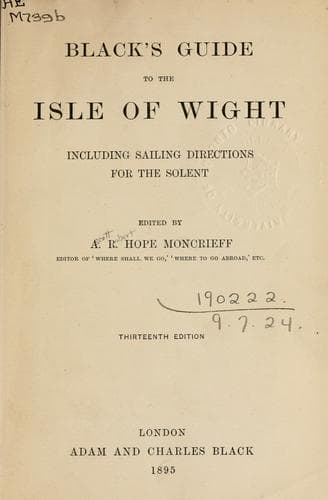
Isle of WightMoncrieff, A. R. Hope (Ascott Robert Hope)
History
Isle of Wight
Moncrieff, A. R. Hope (Ascott Robert Hope)
Isle of Wight (England) -- Description and travel
Among its other misfortunes this little Yarmouth has had that of being
over-crowed by the bloated renown of Great Yarmouth, which trumpets
forth many high notes of interest, from its cathedral-like church and
its ancient “Rows,” to its herring fleet and its Cockney paradises. The
author of _David Copperfield_ himself might not find much to say about
the Isle of Wight Yarmouth, which yet, by its past dignity, seems to
demand a chapter, where it must play at least the part of text like that
blessed word Mesopotamia. If we writers might never fill a few pages
without having anything particular to say, what would become of the
circulating libraries? So let us see what may be said under the head of
Yarmouth, taken with a stretch of country beyond which deserves to be
better known than it is to the Island visitors.
This little town or big village is best known to strangers by the pier
of the shortest crossing from Lymington, not indeed the most convenient
one, as there is a gap between the landing and the station, and trains
of the Freshwater line seem to run in no close connection with the
steamers, or make only a mocking show of connection that adds insult to
injury. So one may find oneself stranded here for an hour or two, unless
he can go straight on by coach to Freshwater Bay or to Totland Bay, to
which also some of the steamers run in the season. But weak-stomached
voyagers hail the half-hour’s passage as being mostly in the winding mud
flats of the Lymington River, with an open prospect towards the Needles,
and the low walls of Hurst Castle at the point of its long spit.
Hereabouts is the proposed line of a Solent Tunnel which as yet remains
in the air, but as _fait accompli_ might lift poor Yarmouth’s head, or
Totland Bay’s, to the height of proud Ryde.
Simple as it stands now, Yarmouth is one of the Island’s three ancient
boroughs, old enough to have been more than once burned by French
excursionists in the bad old days, and a place of comparatively more
importance a century ago, when fleets of sails might be wind-bound here
for weeks. As bulwark against French and other attacks, a castle was
built at the mouth of the Yar, whose remains are now enclosed in the
grounds of the Pier Hotel, itself still recalling its state when it was
the mansion of Sir Robert Holmes, and entertained Charles II. Else,
Yarmouth has not much to boast in the way of architecture, unless some
quaint old houses, refreshing after the modernity of Totland Bay. The
Church, dating from James I., shows a collection of Holmes’ monuments,
chief among them a fine statue of Sir Robert Holmes, which had a curious
history: it is
[Illustration: YARMOUTH]
Public-domain text, read in full here on John Shaqi.
Reviews
Reviews
No reviews yet
Be the first to share your thoughts on this work.
Elsewhere in the archive
Join the Discussion
Join the discussion
Sign in to leave a comment or review.
Sign InorCreate an account