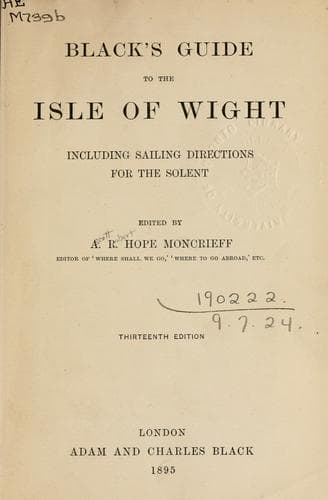
Isle of WightMoncrieff, A. R. Hope (Ascott Robert Hope)
History
Isle of Wight
Moncrieff, A. R. Hope (Ascott Robert Hope)
Isle of Wight (England) -- Description and travel
This does not exhaust the catalogue of stories which have their scene
here. Professor Church’s _Count of the Saxon Shore_ and Mr F. Cowper’s
_Captain of the Wight_ come rather into the category of boys’ books, the
latter being specially well stuffed with swashing blows and strong
“language of the period.” Mr Headon Hill’s _Spies of the Wight_ gives a
lurid peep into the machinations of a foreign power against our coast
defences, and the tricks of a Fosco-like villain foiled by one of those
Sherlock Holmes intellects that find it so easy to discover what has
been invented for discovery. We are now approaching the most fashionable
resort in the Island, and there perhaps may come across some of those
scandals and sins of society that give a popular relish to so much of
our circulating literature. Meanwhile, since there is nothing like
seeing ourselves as others see us, for a careful picture of Isle of
Wight life, let us turn to a French story-teller whose modesty might
prefer his name to be withheld.
A collection of novelettes entitled _Amours Anglais_, one of which
centres in the Island, is put forth by this writer as an essay in a new
school of romance. His preface, dated from “Margate, Isle of Thanet,”
lets us understand how after long years of sojourn in England he has
observed John Bull as closely and profoundly as is possible for a
stranger to do, and that he proposes to present English life to his
countrymen, stripped of the ridiculous exterior with which it is charged
by their caricaturing spirit. This sympathising stranger knows the
British soul to be not less interesting and more wholesome than the
gloomy and flabby Russian sentiment that has had such a vogue in French
fiction. To the facts of _Outre-Manche_, then, he will apply his native
“psychologic methods,” writing as a Frenchman what he has felt as an
Englishman. His aim is “to create an international _genre_ of romance,
marrying our taste to the humour and the morality of our neighbours.
Have I succeeded? The public will judge.” So, with the best intentions,
our _entente cordialiste_ appeals to his French readers. Let the English
public now judge.
Public-domain text, read in full here on John Shaqi.
Reviews
Reviews
No reviews yet
Be the first to share your thoughts on this work.
Elsewhere in the archive
Join the Discussion
Join the discussion
Sign in to leave a comment or review.
Sign InorCreate an account