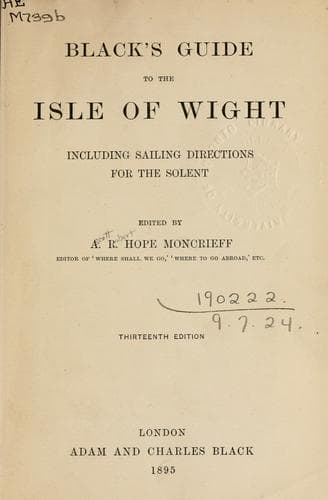
Isle of WightMoncrieff, A. R. Hope (Ascott Robert Hope)
History
Isle of Wight
Moncrieff, A. R. Hope (Ascott Robert Hope)
Isle of Wight (England) -- Description and travel
Lilian’s cheeks glowed with shame under this insult, and she took the
first opportunity of stealing away to weep all alone by moonlight. But
Harry, indignantly sympathetic, had followed her, guided by her sobs.
In vain she bid him return to his Arabella. Arabella indeed! He had
never much cared for Miss Jones, whom he now detested after such an
exhibition of ill-natured rudeness. As they strolled on the Freshwater
esplanade, Lilian’s foot slipped; and Harry, holding-her up, took the
opportunity to clasp the heroine in his arms. They went back an engaged
couple--_cela va sans dire_.
The courtship had to be done on the sly; yet the young couple must have
attracted suspicion in any more censorious neighbourhood, such as that
not far away, which we hear of, on good authority, as bubbling over with
“gossip, scandal, and spite.” Every day Harry rode from Ryde to Newport,
met at her garden-gate by Lilian, to keep company with all the freedom
of a British maiden and of an innocent heart. “I gave sugar to his
horse, which was called Fly; we picked flowers, and ran races against
each other.” Only the jealous Jedediah guessed what was going on. When
Harry entered the house, he feigned great attention to the religious
exhortations of the father, but could not make way in his good-will,
while Jedediah scowled at every sight of his rival, whose ring Lilian
wore “hidden under my mitten,” yet not perhaps from that
green-spectacled monster.
Autumn broke up the gay non-conformist society of the Island. The Misses
Jones went off to make fresh conquests at Brighton. Harry had to go back
to his London office, but every week-end he took a bed at the “Bugle”
Hotel of Newport, spent Sunday with his _fiancée’s_ family, and returned
to business by the last train. In spite of this breaking of the Sabbath,
the Baptist minister believed that the young man came all the way from
London to hear him preach. But at last the neighbours began to talk; so
the lovers saw themselves obliged to meet only in secret, and to pour
out their hearts in long letters. The worst of it was that Harry grew
cross and impatient. His father, a rich shipowner at Cardiff, would
never consent to his engagement with the daughter of a poor Baptist
preacher. If he knew, he would cut his son off with a shilling, “as the
law authorises him to do.” The Rev. Mr North, for his part, would frown
on his child’s union with a family far from sound in faith. Lilian was
for a long engagement, in hopes that the old people would come round.
Harry’s more heroic remedy was an immediate secret marriage such as, in
tale and history, has sooner or later the effect of forcing parents to
make the best of a bad business. The wooer becomes ill-temperedly
pressing; Lilian at length consents; but when these unpractical
youngsters lay their heads together, they run up at once against the
serious difficulty of finding a minister to marry them. Then the heroine
Public-domain text, read in full here on John Shaqi.
Reviews
Reviews
No reviews yet
Be the first to share your thoughts on this work.
Elsewhere in the archive
Join the Discussion
Join the discussion
Sign in to leave a comment or review.
Sign InorCreate an account