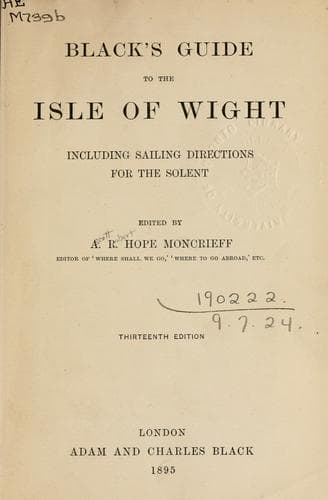
Isle of WightMoncrieff, A. R. Hope (Ascott Robert Hope)
History
Isle of Wight
Moncrieff, A. R. Hope (Ascott Robert Hope)
Isle of Wight (England) -- Description and travel
I do not know to what stratagems Harry had recourse for obtaining
the necessary papers. What is certain is that we were married on
Easter Tuesday, before the Registrar of the county, after which
Jedediah gave us the nuptial benediction in a little chapel of the
Baptist communion situated in the environs of Plymouth
(_Portsmouth_). He married us without looking at us. I have never
seen a scene more strange, nor a man more unfortunate.
He refused to come and share the wedding-cake with us, which we ate
at my sister’s.
But those English love-marriages between rash young people by no mean
always end in living happily all the rest of their days; and the story
soon turns tragic, its scene shifting from the Island. After that secret
wedding, Harry returns to London, leaving his wife in an awkward
position, where Jedediah is her only comfort. Love still blinds her eyes
to the selfishness of Harry; but the reader sees how she might have been
better off with poor Jedediah, who is not such a villain after all, but
only the Dobbin or Seth Bede of the tale. The time comes when her
marriage can no longer be hidden. Harry takes lodgings for her in London
at the house of a Mrs Benson, whose husband, being employed at the
Bricklayers’ Arms Goods Station, finds it convenient to live in a
four-roomed house in Shoreditch, too large for a quiet couple.
To this sympathetic landlady, Lilian relates the foregoing story, with
many tears and gulps of _tisane_, a refreshment, it seems, known to
Shoreditch sickbeds. Her child is born dead. The young mother in her
feverish weakness fancies that Jedediah has revengefully contrived some
defect in the ceremony, and cries out to have her marriage made legally
complete at the parish church. Harry, moved by her delirium, writes to
both parents, confessing the truth. A curate is sent for, who politely
but hastily says a few prayers at the sick-bed, then hurries off to a
tea-party at the West-end. Lilian dies the same night. Harry weeps, to
be sure, but soon grows tired of sitting up with the dead, and comes
down to smoke a pipe with the landlord.
Next day Gordon _père_ arrives in a great rage, but, at the sight of his
dead daughter-in-law, he is touched to the point of taking off his hat,
as English gentlemen, it appears, will do on such special occasions. Mr
North, on his arrival, shows natural grief, which is soon turned to
wrath by the sight of a crucifix laid on his daughter’s breast, contrary
to “the statute of the fifteenth year of Elizabeth,” as he knows well;
and he gives up all hope of her eternal welfare, on hearing how her last
moments had been corrupted by the prayers of an Anglican priest. Mrs
Benson, who takes that wide view of religion spread in France by such
divines as the Savoyard Vicar and such poets as Beranger, in vain tries
to comfort him.
Public-domain text, read in full here on John Shaqi.
Reviews
Reviews
No reviews yet
Be the first to share your thoughts on this work.
Elsewhere in the archive
Join the Discussion
Join the discussion
Sign in to leave a comment or review.
Sign InorCreate an account