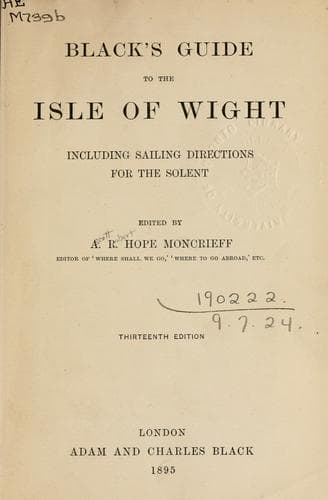
Isle of WightMoncrieff, A. R. Hope (Ascott Robert Hope)
History
Isle of Wight
Moncrieff, A. R. Hope (Ascott Robert Hope)
Isle of Wight (England) -- Description and travel
Of all the naval pageants these shores have beheld, none could be more
impressive than when, that dull winter afternoon of 1901, stirred only
by tolling bells and booming minute guns, the body of Europe’s most
venerated Sovereign was borne across the Solent through a mile-long lane
of British and foreign war-ships, on her last journey to Windsor.
THE GATES OF THE ISLAND
Before turning away from the Solent, we may take a look at its northern
shores, and the mainland ports making gateways of the strait and island
that serve their populations as playground.
Cowes lies opposite Southampton, with which it has direct communication
up the long inlet of Southampton Water, the least expeditious passage to
the Island, but the pleasantest in fine weather, most of the hour’s
voyage being by that wooded arm of the Solent, where on one side stretch
the heaths and copses of the New Forest’s Beaulieu corner; while the
other is broken by the mouths of the Hamble and of the Itchen. Between
these creeks, stands conspicuous the Netley Hospital, said to be the
longest building in England, overshadowing Netley Castle, adapted as a
modern mansion, and the picturesque old ruins of Netley Abbey, fallen to
be a junketing resort for Southampton. The Royal Victoria Hospital, a
name well earned by the late Queen’s interest in it, was built for
soldiers invalided in the Crimean War, and became to our army what the
Haslar Hospital, at Gosport, is to the navy. Netley Bay is now
headquarters of the Motor-Yacht Club, housed in an ex-Admiralty yacht.
Too many of the Isle of Wight passengers who embark or land at
Southampton Pier, know not what a mistake they make in hurrying on
without a look at one of the most interesting old towns in England,
which from the railway or the docks may appear to be no more than one of
its most prosperous ports. The Northam and Southam of early days have
here grown into a still growing municipality, whose lively streets imbed
some most notable fragments of the past, now reverently preserved. The
largest portion of the walls is a stretch of curious archways facing the
west shore, behind which filthily picturesque slums have been cleared
away and replaced by a pile of model lodging-houses that our era of
sanitation puts in bold contrast with the Middle Ages. These Arcades, as
they are called, seem to have been the defensible entrances to a line of
mansions, very eligible for their period. Behind, beside the spire of
Southampton’s oldest church, is a Tudor house said to have accommodated
Henry VIII. and Anne Boleyn on their brief honeymoon. The oldest of the
houses on the sea front, by the “King’s Quay” as it used to be called,
is believed to have been tenanted by King John, perhaps by Henry III;
and among the many King John’s lodges and King John’s palaces scattered
over England, this seems to have the best right to the honour thus
claimed for it.
Public-domain text, read in full here on John Shaqi.
Reviews
Reviews
No reviews yet
Be the first to share your thoughts on this work.
Elsewhere in the archive
Join the Discussion
Join the discussion
Sign in to leave a comment or review.
Sign InorCreate an account