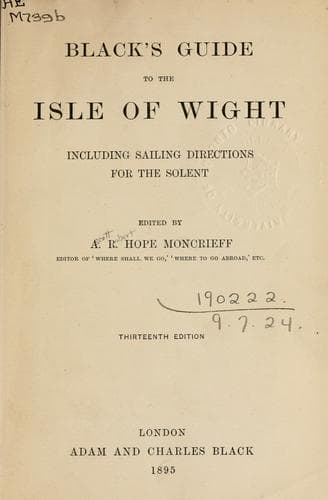
Isle of WightMoncrieff, A. R. Hope (Ascott Robert Hope)
History
Isle of Wight
Moncrieff, A. R. Hope (Ascott Robert Hope)
Isle of Wight (England) -- Description and travel
The woods of the New Forest come within a few miles of Southampton,
which has other pleasant scenes about its salubrious site on a gravelly
spit projecting between the Itchen and the Test, angling streams of
fame. Its sea-front on the West Bay is hardly an admirable point unless
at high water, as it more often shows a green expanse of slime and
malodorous weed that by no means _ladet zum Baden_, fit rather for the
paddling of adventurous mud larks. But the citizens, more ingenious than
Canute, catch the elusive tide in a basin that makes an excellent
open-air swimming bath. The strong smell of seaweed is offensive to some
strangers, who may comfort themselves by considering it as wholesome:
had this rubbish bank been German, it would probably be utilised for
some sort of _Kur_, with a three weeks’ course of sanatory sniffs, and a
_Nach-kur_ of whey treatment in the Isle of Wight. Southampton had once
indeed a chalybeate spa of its own, to which its Victoria Rooms seems a
monument.
This old seaport has had notable sons, from Isaac Watts, whose statue in
the park looks down on a flower-bed visited by busy bees, to Charles
Dibdin, whose nautical songs were not so well adapted to the restraint
of angry passions. If all tales be true, its oldest celebrity is that
Bevis of Hampton, whose story, indeed, inconvenient critics father upon
a twelfth century French romance; and it has certainly been told in
several languages: so far off as Venice, this widely popular hero is
found figuring as a sort of local Punch. But for the confusion of all
who doubt his Hampshire origin, the name Bevis Mount still preserves on
the Itchen bank the memory of a stronghold he threw up here against the
Danes; and who was he if not Bevis of Hampton? The story also gives him
a connection with the Isle of Wight; so, as we began with dull history,
let us draw towards an end with a taste of what, one fears, must count
rather as fiction, perhaps expanded about some core of legendary fact.
_Sir Bevis of Hampton_ was one of the favourite romances of the feudal
age; and his adventures were familiar to John Bunyan’s unregenerate
youth, if little known to the Southampton boys who in our time pass the
sixth standard, however well versed they may be in our own “penny
dreadful” literature. Yet _Ivanhoe_, _Pathfinder_, and the _Three
Musketeers_ rolled into one, would make a tame hero beside Sir Bevis. As
became a hero, he had difficulties to contend with all along, the first
being an unnatural mother who, one grieves to say, was a Scottish
princess. Married to Guy, Earl of Southampton, whose name suggests some
connection with the still more famous lord of Warwick, she preferred a
foreign prince, Sir Murdour, a name that gives plain hint of his nature,
as well as a dim anticipation of David Copperfield’s tyrant.
Public-domain text, read in full here on John Shaqi.
Reviews
Reviews
No reviews yet
Be the first to share your thoughts on this work.
Elsewhere in the archive
Join the Discussion
Join the discussion
Sign in to leave a comment or review.
Sign InorCreate an account