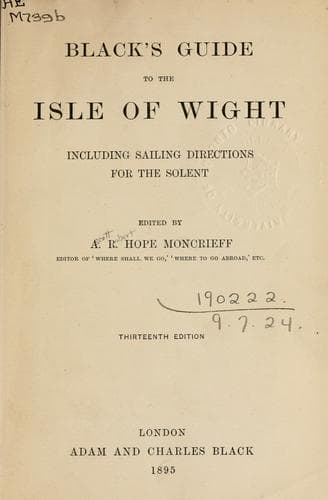
Isle of WightMoncrieff, A. R. Hope (Ascott Robert Hope)
History
Isle of Wight
Moncrieff, A. R. Hope (Ascott Robert Hope)
Isle of Wight (England) -- Description and travel
These petty exploits had made merely the work of our hero’s ’prentice
hand; the time was now come for him to be dubbed a knight, presented on
the occasion with a marvellous sword called “Morglay,” and the best
horse in the world, by name “Arundel.” Ermyn had soon need of a peerless
champion. Bradmond, King of Damascus, was demanding Josyan’s hand, with
threats to lay waste the land if his suit were refused; but a lad of
mettle like Bevis, of course, found no difficulty in laying low that
proud Paynim and all his host. Josyan was so lost in admiration of such
prowess, that she proposed to her Christian knight after a somewhat
unmaidenly fashion; but Bevis would give her no encouragement till, for
his sake, she professed herself ready to renounce the Moslem faith.
But when the king heard how his daughter was being converted to
Christianity, his patience came to an end. Not daring to use open
violence against the invincible youth, he sent him on an embassy to King
Bradmond, his late adversary, who at the point of Bevis’ sword had
lately sworn to be Ermyn’s vassal, and was now commanded, on his
allegiance, to secure the bearer of the sealed letter which Bevis
carried to his own destruction. The author of _Hamlet_ may have taken
another hint from this incident. But our impetuous knight needed no
treacherous credentials to get him into trouble. At Damascus he found a
crowd of Saracens worshipping an idol, which his sound principles moved
him to knock over into the mud with proper contempt: the Mohammedans,
whatever their doctrinal shortcomings might be, were, as a matter of
fact, strongly set against idolatry, but Christian minstrels allowed
themselves a poetical license on such points. King Bradmond and all his
men, backed by the fanatical population of Damascus, were odds too great
even for a pious hero. Bevis, fairly overpowered for once, was thrown
into a dungeon with two ravenous dragons to keep him company. It was
only a matter of some twenty-four hours’ combat for him to kill the
dragons with the butt-end of a staff that came to his hand; but hunger
proved a sorer enemy. Now we have the two most familiar lines of this
long poem, as quoted in _King Lear_--
Rats and mice and such small deer,
Were his meat for seven long year.
Public-domain text, read in full here on John Shaqi.
Reviews
Reviews
No reviews yet
Be the first to share your thoughts on this work.
Elsewhere in the archive
Join the Discussion
Join the discussion
Sign in to leave a comment or review.
Sign InorCreate an account