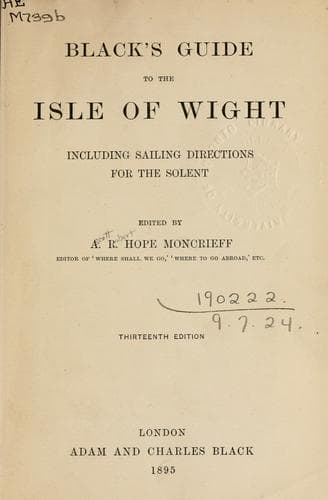
Isle of WightMoncrieff, A. R. Hope (Ascott Robert Hope)
History
Isle of Wight
Moncrieff, A. R. Hope (Ascott Robert Hope)
Isle of Wight (England) -- Description and travel
The chief Solent ferry is, of course, at Portsmouth, whereof tourists
might do well to see more than is seen from the railway line to its
pier, the main knot of Isle of Wight communications, while by Gosport
and Southsea, on either side of the town, are alternative crossings to
Ryde. Portsmouth is not so rich in antiquities as Southampton, its most
notable buildings being the fine modern Church of Portsea, one of the
grandest town-halls in England, and the largest Naval Barracks in the
world; but it is an ancient place, interesting as our chief marine
arsenal, which in case of war might become a Sebastopol or a Port
Arthur. Like Plymouth, it is rather a group of towns, Portsmouth,
Portsea, and Southsea, run together beside the wide inlet of the
harbour, on the other side of which stands Gosport. Naturally it has a
marked naval flavour, strongest on the Hard, familiar to so many
generations of Jacks and Sues, behind which the narrow main street of
Landport makes such a lively scene of a Saturday night. Off Gosport Hard
is moored the old _Victory_, whose deck no Briton can tread without
pride, nor would a generous enemy be unmoved on the spot where “mighty
Nelson fell,” and in the gloomy cockpit where he died. Portsmouth has
for another shrine the birthplace of Charles Dickens, at No. 387
Commercial Road, Landport, now cared for as public property and
containing a collection of relics. Walter Besant was also a native, who
has celebrated the scenes of his boyhood in _Celia’s Arbour_.
The great sight is the Dockyard, over which all visitors who can glory
in the name of Briton are conducted by its garrison of Metropolitan
Police; but foreigners must bring special credentials for admission. A
visit to the _enceinte_ of fortifications cannot be recommended, as
these are of a modestly retiring disposition, and make a purposed blank
on the faithful Ordnance Survey maps. Beyond the fort-crowned Downs
behind, some fine country may be reached by tram; but the scenery of the
low island on which Portsmouth has its site, too much consists of
bastions, barracks, prisons, and other useful, but unlovely
institutions.
Public-domain text, read in full here on John Shaqi.
Reviews
Reviews
No reviews yet
Be the first to share your thoughts on this work.
Elsewhere in the archive
Join the Discussion
Join the discussion
Sign in to leave a comment or review.
Sign InorCreate an account