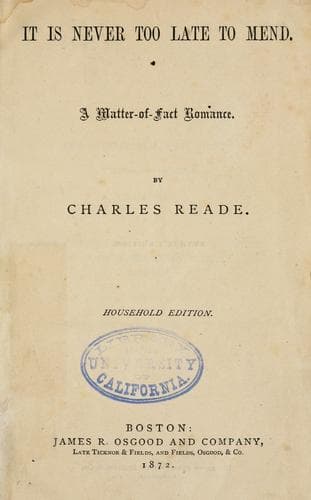
Great Britain -- Social conditions -- 19th century -- Fiction
The turnkeys, a little staggered by his firmness, began to confer in
whispers. The chaplain, who was one of your decided men, could not wait
the consultation. He sprang to Robinson's head and began to undo the
collar. The others, seeing this decided move, came and helped him. The
collar and the strap being loosed, the thief's body, ensacked as it was,
fell helplessly forward. He had fainted during the discussion; in fact,
his senses were shut when the chaplain first came to the cell. The
chaplain caught him, and being a very strong man, saved him from a
dangerous fall and seated him gently with his back to the wall. Water
was sprinkled in his face. The chaplain went hastily to find the
governor. He came to him pale and out of breath.
“I found the turnkeys outraging a prisoner.”
“Indeed!” said the governor. It was a new idea to him that anything
could be an outrage on a prisoner.
“They confessed they had not your authority, so I took upon me to undo
their act.”
“Humph!”
“I now leave the matter in your hands, sir.”
“I will see into it, sir.”
The chaplain left Mr. Hawes abruptly, for he was seized with a sudden
languor and nausea; he went to his own house and there he was violently
sick. Shaking off as quickly as he could this weakness, he went at once
to Robinson's cell. He found him coiled up like a snake. He came hastily
into the cell with the natural effusion of a man who had taken another
man's part.
“I want to ask you one question: What had you done that they should use
you like that?”
No answer.
“It is not from idle curiosity I ask you, but that I may be able to
advise you, or intercede for you if the punishment should appear too
severe for the offense.”
No answer.
“Come, I would wait here ever so long upon the chance of your speaking
to me if you were the only prisoner, but there are others in their
solitude longing for me; time is precious; will you speak to one who
desires to be your friend?”
No answer.
A flush of impatience and anger crossed the chaplain's brow. In most men
it would have found vent in words. This man but turned away to hide it
from its object. He gulped his brief ire down and said only, “So then I
am never to be any use to you,” and went sorrowfully away.
Robinson coiled himself up a little tighter, and hugged his hatred of
all mankind closer, like a treasure that some one had just tried to do
him out of.
As the chaplain came out of his cell he was met by Hawes, whose
countenance wore a gloomy expression that soon found its way into words.
“The chaplain is not allowed to interfere between me and the prisoners
in this jail.”
“Explain, Mr. Hawes.”
“You have been and ordered my turnkeys to relax punishment.”
“You forget, Mr. Hawes, I explained to you that they were acting without
the requisite authority from you.”
“That is all right, and I have called them to account, but then you are
not to order them either; you should have applied to me.”
Public-domain text, read in full here on John Shaqi.
Reviews
Reviews
No reviews yet
Be the first to share your thoughts on this work.
Elsewhere in the archive
Join the Discussion
Join the discussion
Sign in to leave a comment or review.
Sign InorCreate an account