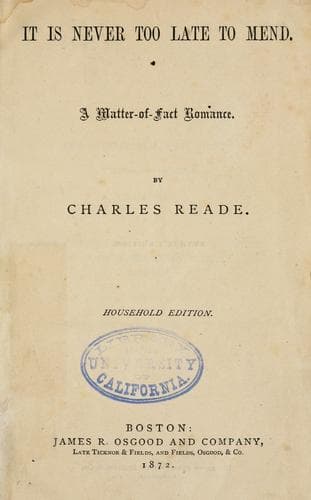
Great Britain -- Social conditions -- 19th century -- Fiction
Hodges. Pity you wasn't in chapel, Mr. Fry.
Fry. Why?
Hodges. The new chaplain!
Fry. Well, what did he do?
Hodges. He waked 'em all up, I can tell you. Governor couldn't get a
wink all the sermon.
Fry. What did he tell you?
Hodges. Told us he loved us.
Fry. Loved who?
Hodges. All of us. Governor, turnkeys, and especially the prisoners,
because they were in trouble. “My Master loves you, though He hates your
sins,” says he; and “I love every mother's son of you.” What d'ye think
of that? He loves the whole biling! Told 'em so, however.
Fry. Loves 'em, does he? Well, that's a new lay! After all, there's no
accounting for tastes, you know. Haw! haw!
Hodges. Haw! haw! ho!
This same Sunday afternoon, soon after service, the chaplain came to
Robinson's cell. Evans unlocked it, looking rather uneasy, and would
have come in with the reverend gentleman; but he forbade him and walked
quickly into the cell, as Van Amburgh goes among his leopards and
panthers. He had in his hand a little box.
“I have brought you some ointment--some nice cooling ointment,” said he,
“to rub on your neck. I saw it was frayed by that collar.”
(Pause.) No answer.
“Will you let me see you use it?”
No answer.
“Come!”
No answer.
The chaplain took the box off the table, opened it and went up to
Robinson and began quietly to apply some of the grateful soothing
ointment to his frayed throat. The man trembled all over. The chaplain
kept his eye calm but firm upon him, as on a dog of doubtful temper.
Robinson put up his hand in a feeble sort of way to prevent the other
from doing him good. His reverence took the said hand in a quiet but
powerful grasp, and applied the ointment all the same. Robinson said
nothing, but he was seized with this extraordinary trembling.
“Good-by,” said his reverence kindly. “I leave you the box; and see,
here are some tracts I have selected for you. They are not dull; there
are stories in them, and the dialogue is pretty good. It is nearer
nature than you will find it in works of greater pretension. Here a
carpenter talks something like a carpenter, and a footman something
like a footman, and a factory-girl something like a girl employed in a
factory. They don't all talk book--you will be able to read them. Begin
with this one, 'The Wages of Sin are Death.' Good-by!” And with these
words and a kind smile he left the cell.
“From the chaplain, sir,” said Evans to the governor, touching his hat.
“DEAR SIR--Will you be good enough to send me by the bearer a copy of
the prison rules, especially those that treat of the punishments to be
inflicted on prisoners?
“I am,
“Yours, etc.”
Hawes had no sooner read this innocent-looking missive, than he burst
out into a tide of execrations; he concluded by saying, “Tell him I have
not got a spare copy; Mr. Jones will give him his.”
Public-domain text, read in full here on John Shaqi.
Reviews
Reviews
No reviews yet
Be the first to share your thoughts on this work.
Elsewhere in the archive
Join the Discussion
Join the discussion
Sign in to leave a comment or review.
Sign InorCreate an account