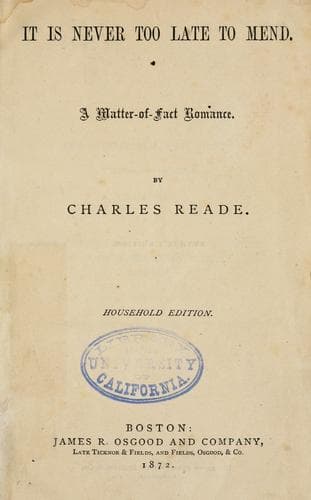
Great Britain -- Social conditions -- 19th century -- Fiction
Now, at the beginning of this argument Mr. Eden was determined not to
go; but on reflection he made up his mind to, for this reason: “This,”
said he to himself, “is an act of uncommon virtue and self-denial in
this poor fellow. I must not balk it, for it will be good for his soul;
it is a step on the right road. This good and, I might say, noble act is
a foundation-stone on which I ought to try and build an honest man and a
Christian.”
“Well, then, as you are so considerate I will go.”
“Thank you.”
“Can I do nothing for you before I go?”
“No, sir; you have done all a man can; yes, you can do something--you
spoke a word to me when you came; it is a word I am not worthy of, but
still if you could leave me that word it would be a companion for me.”
“Brother!”
“Thank you.”
When he heard Mr. Eden's steps grow fainter and fainter, and at last
inaudible, Robinson groaned; the darkness turned blacker and the
solitude more desolate than ever.
Mr. Eden paced the corridors in meditation. “It is never too late to
mend!” he said. “This man seemed an unredeemable brute, yet his heart
was to be touched by persevering kindness; and once touched, how much
of goodness left in his fallen nature--genuine gratitude, and even the
embers of self-respect. 'I hate myself for my conduct in the cell; it
would disgrace me in my own eyes if I let you shiver at my door.' Poor
fellow, my heart yearns toward him for that. 'Go, or you will make me
more unhappy.' Why, that was real delicacy. I must not let him suffer
for it. In an hour I will go back to him. If he is asleep, well and
good; if not, there I stay till morning.”
He went to his room and worked. The hour soon glided by to him; not so
to the poor prisoner. At two in the morning Mr. Eden came softly back to
the dark cell to see whether Robinson was asleep. He scratched the door
with a key. A loud, unsteady voice cried out, “What is that?”
“It is I, brother.”
“Why are you not in your bed?”
“I couldn't sleep for anxiety. Come, chat with me till you feel sleepy.
How did you color those cards?”
“I found a coal and a bit of brick in the yard. I pounded them and mixed
them with water and laid them on with a brush I had made and hid.”
“Very ingenious! Are you cold?”
“No.”
“Because your voice trembles.”
“Does it?”
“What is the matter?”
“Can't you guess?”
“No! But I remember you used to tremble when I spoke to you in the
cell. Why was that? Have your nerves been shaken by ill-usage, my poor
fellow?”
“Oh, no! it is not that.”
“Tell me, then!”
“Oh, sir! you know all a poor fellow feels. You can guess what made me
tremble, and makes me tremble now, like an aspen I do.”
“No, indeed! pray tell me! Are we not friends?”
“The best ever I had, or ever shall.”
“Then tell me.”
“I'll try; but it is a long story, and the door is so thick.”
“Ah! but I hear you better now. I have got used to your voice.
Public-domain text, read in full here on John Shaqi.
Reviews
Reviews
No reviews yet
Be the first to share your thoughts on this work.
Elsewhere in the archive
Join the Discussion
Join the discussion
Sign in to leave a comment or review.
Sign InorCreate an account