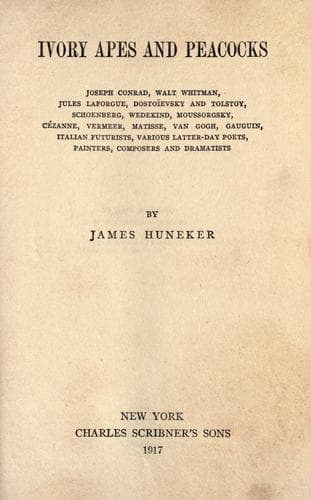
Art; Literature, Modern -- History and criticism; Music -- History and criticism
His landscapes were those of a visionary in an Arcadia where the ugly
is elevated to the tragic. Tragic, too, were his representations of
his fellow men. Such every-day incidents as a funeral became
transfigured in the sardonic humour of this pessimist. No one had such
a quick eye in detecting the mean souls of interested mourners at the
interment of a relative. I possess an original signed lithograph
called, The Curious Ones, which shows a procession returning afoot
from a funeral. Daumier, himself, could not beat the variety of
expressions shown in this print. The silk hat (and Goya was the first
among modern artists to prove its value as a motive) plays a role in
the Munch plates. His death-room scenes are unapproachable in seizing
the fleeting atmosphere of the last hour. The fear of death, the very
fear of fear, Maeterlinck has created by a species of creeping
dialogue. (The Intruder is an example), but Edvard Munch working in an
art of two dimensions where impressions must be simultaneous, is more
dynamic. The shrill dissonance in his work is instantly reflected in
the brain of the speaker. In his best work--not his skeletons dancing
with plump girls, or the youthful macabre extravagances after the
manner of Rops, Rethel, De Groux, or James Ensor--he does invoke a
genuine thrill.
Psychologic, in the true sense of that much-abused word, are his
portraits; indeed, I am not sure that his portraits will play second
fiddle to his purely imaginative work in the future. There is the
Strindberg, certainly the most authoritative presentment of that
strange, unhappy soul. The portraits of Hans Jaeger, the poet (in oil),
the etched head of Doctor A., the etched head of Sigbjorn Obstfelder,
poet who died young, as well as the self-portraits and the splendidly
constructed figure and eloquent expression in the portrait of a woman,
an oil-painting now in the National Gallery, Christiania, these and
many others serve as testimony to a sympathetic divination of
character. His etched surfaces are never as silvery as those of Anders
Zorn, who is a virtuoso in the management of the needle. Not that
Munch disdains good craftsmanship, but he is obsessed by character;
this is the key-note of his art. How finely he expresses envy,
jealousy, hatred, covetousness, and the vampire that sometimes lurks
in the soul of woman. An etching, Hypocrisy, with its faint leer on
the lips of a woman, is a little masterpiece. His sick people are
pitiful, that is, when they are not grotesque; the entire tragedy of
blasted childhood is in his portrait of The Sick Child.
Public-domain text, read in full here on John Shaqi.
Reviews
Reviews
No reviews yet
Be the first to share your thoughts on this work.
Elsewhere in the archive
Join the Discussion
Join the discussion
Sign in to leave a comment or review.
Sign InorCreate an account