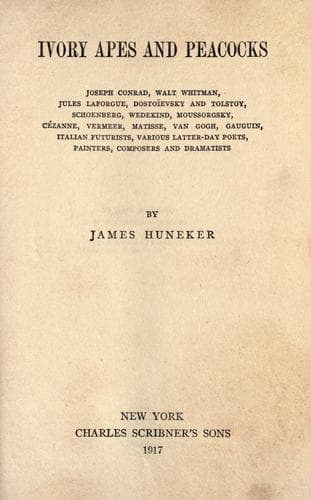
Art; Literature, Modern -- History and criticism; Music -- History and criticism
Because I had strolled over to buy a newspaper at a kiosk hard by the
Rijks Museum in Amsterdam, I discovered an announcement that the
Italian Futurists were holding an exhibition in De Roos Gallery on the
Rokindam. This was early in September, 1912. What a chance, I thought,
to compare the new with the old. After that glorious trinity,
Rembrandt, Frans Hals, and Vermeer, hanging in the Rijks, what a
piquant contrast to study the new-fangled heresies and fantastic
high-kicking of the Futurists! This group, consisting of five Italian
painters in company with the poet Marinetti as a self-constituted chef
d'ecole, is perfectly agreed that all the old conventions of pictorial
art have outlived their usefulness; that drawing, colour, perspective,
harmonious composition must walk the plank as far as they are
concerned; in a word, classic, romantic, impressionistic art is
doomed; only symbolism will endure; for symbolism only is there a
future. Signor Marinetti, who coined the hideous word, "Futurism,"
goes still further. Literature, too, must throw off the yoke of
syntax. The adjective must be abolished, the verb of the infinite
should be always employed; the adverb must follow the adjective; every
substantive should have its double; away with punctuation; you must
"orchestrate" your language (this outrivals Rene Ghil); the personal
pronoun is also to disappear with the rest of the outmoded literary
baggage, which was once so useful to such moribund mediocrities (the
phrase is of Marinetti's making) as Dante, Petrarch, Tasso, Alfieri;
even D'Annunzio is become a moss-covered reactionary.
I purposely mention Marinetti and his manifesto for the reason that
this movement in painting and sculpture is decidedly "literary," the
very accusation of which makes the insurgents mightily rage. For
example, I came across in _De Kunst_, a Dutch art publication in
Amsterdam, a specimen of Marinetti's sublimated prose, the one page of
which is supposed to contain more suggestive images and ideas than a
library written in the old-fashioned manner. Here are a few lines
(Battle is the title and the prose is in French):
"Bataille. Poids-odeur. Midi 3/4 flutes glapissement embrasement toumb
toumb alarme gargaresch eraquement erepitation marche," etc.
Public-domain text, read in full here on John Shaqi.
Reviews
Reviews
No reviews yet
Be the first to share your thoughts on this work.
Elsewhere in the archive
Join the Discussion
Join the discussion
Sign in to leave a comment or review.
Sign InorCreate an account