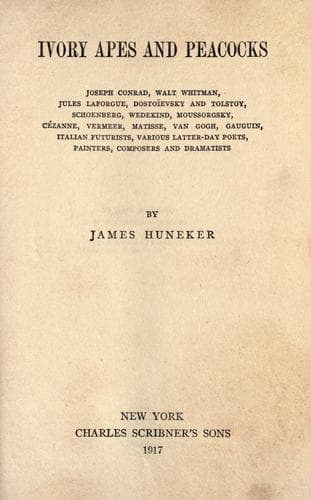
Art; Literature, Modern -- History and criticism; Music -- History and criticism
But Maupassant affected Tolstoy as he had affected Turgenieff. Guy has
told us of his first meeting with the latter, an artist superior to
Tolstoy. "The first time I saw Turgenieff was at Gustave Flaubert's--a
door opened; a giant came in, a giant with a silver head, as they
would say in a fairy tale." This must have been in 1876, for in a
letter dated January 24, 1877, Turgenieff writes: "Poor Maupassant is
losing all his hair. He came to see me. He is as nice as ever, but
very ugly just at present." In 1880 the young man published a volume
of poetry, Des Vers. He was thirty years old (born August 5, 1850).
The literary apprenticeship of Guy to Gustave Flaubert is a
thrice-told tale, and signifies only this: If the pupil had not been
richly endowed all the lessons of Flaubert would have availed him
little. Perhaps the anecdote has been overdone; Maupassant has related
it in the preface to Pierre et Jean, and in the introduction to the
George Sand-Flaubert correspondence--now at the head of the edition of
Bouvard et Pecuchet. There are letters of Flaubert to his disciple
full of his explosive good nature, big heart, irascibility and
generous outpouring on the subject of his art. The thing that
surprises a close student of this episode and its outcome is that
Maupassant was in reality so unlike his master. And when I further
insist that the younger man appropriated whole scenes from Flaubert
for his longer stories, especially from L'Education Sentimentale, I
feel that I am uttering a paradox.
What I mean is this: Maupassant's temperament was utterly different
from Flaubert's. They were both prosecuted for certain things they
wrote, Guy for a poem in 1880, at Estampes; there had been a detraque
nervous system in both cases. Yet, similar in ideals and physical
peculiarities as were these two men, there was a profound psychical
gulf between their temperaments. Flaubert was a great genius, a path
breaker, a philosophic poet, and the author of La Tentation de St.
Antoine, the nearest approach that France can show to a prose epic,
and a book of beauty and originality. Maupassant was a great talent,
and a growing one when disease cut him down. He imitated the externals
of Flaubert, his irony, his vivid power of picture-making; even his
pessimism he developed--though that was personal, as we shall soon
see. And yet his work is utterly unlike Flaubert, probably unlike what
Flaubert had hoped for--the old man died in 1881 and therefore did not
live to enjoy Maupassant in full bloom. If it did not sound quite
heretical I should be tempted to assert that the writer Maupassant
most patterned after, was Prosper Merimee, an artist detested by
Flaubert because of his hard style. It is this precise style that
Maupassant exhibits but coupled with a clarity, an ease, and a grace
that Merimee could not boast. Of Flaubert's harmonious and
imaginatively coloured manner, Maupassant shows no trace in his six
novels and his two hundred and odd tales.
Public-domain text, read in full here on John Shaqi.
Reviews
Reviews
No reviews yet
Be the first to share your thoughts on this work.
Elsewhere in the archive
Join the Discussion
Join the discussion
Sign in to leave a comment or review.
Sign InorCreate an account