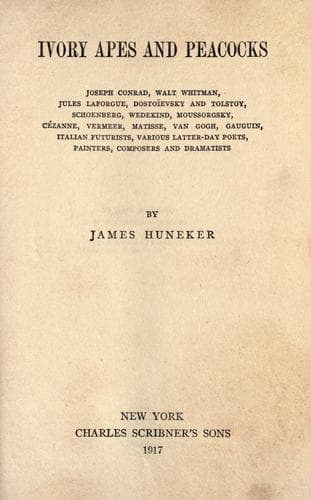
Art; Literature, Modern -- History and criticism; Music -- History and criticism
His men and women are not precisely pagan, nor are they biblical. But
they reveal traits of both strained through a drastic "modern"
intellect. They are not abstractions; the men are virile, the women
maternal. There is the spirit of humanity, not of decadence. Puvis,
like Moreau, did not turn his back to the rising sun. He admired
Degas, Manet, Monet. At first he patterned after his friend
Chasseriau, a fine and too-little-known painter, and at one time a
mural decorator before he became immersed in Oriental themes. The
lenten landscapes of Puvis are not merely scenic backgrounds, but
integral parts of the general decorative web, and they are not
conceived in No Man's Land, but selected from the vicinity of Paris.
Puvis is by no means a virtuoso. His pace is usually andante; but he
knows how to evoke a mood, summon the solemn music of mural spaces.
His is a theme with variations. The wall or ceiling is ever the theme.
His crabbed fugues soon melt into the larger austere music of the
wall. His choral walls are true epopees. He is a master harmonist. He
sounds oftener the symphonic than the lyric note. He gains his most
moving effects without setting in motion the creaking allegorical
machinery of the academy. He shows the simple attitudes of life
transfigured without rhetoric. He avoids frigid allegory, yet employs
symbols. His tonal attenuations, elliptical and syncopated rhythms,
his atmosphere of the remote, the mysterious--all these give the
spectator the sense of serenity, momentary freedom from the
feverishness of every-day life, and suggest the lofty wisdom of the
classic poets. But the serpent of futile melancholy, of the brief
cadence of mortal dreams, and of the vanishing seconds that defile
down the corridor of time, has stolen into this Garden of the
Hesperides. Puvis de Chavannes, no more than Gustave Moreau, could
escape the inquietude of his times. He is occasionally Parisian and
often pessimist.
The inability of his contemporaries to understand his profound
decorative genius, his tact in the handling of the great problem of
lighting--the key is always higher because of the different or softer
light of public buildings and the gloom of churches--and his feeling
for the wall, purely as wall, a flat space, not to be confounded with
the pseudo art that would make the picture like an open window in the
wall, but based on the flatness of the material and the aerial magic
of his spacing, sorely troubled him for half a century. Doubtless it
was his refusal to visit Boston and study there the architectural
conditions of the Public Library that resulted in the hang-fire of his
decorations, though they are of an exalted order. One at least served
as a spring-board for the decorative impulse of Besnard, as may be
noted in his frescoes on the ceiling at the Hotel de Ville, Paris.
Public-domain text, read in full here on John Shaqi.
Reviews
Reviews
No reviews yet
Be the first to share your thoughts on this work.
Elsewhere in the archive
Join the Discussion
Join the discussion
Sign in to leave a comment or review.
Sign InorCreate an account