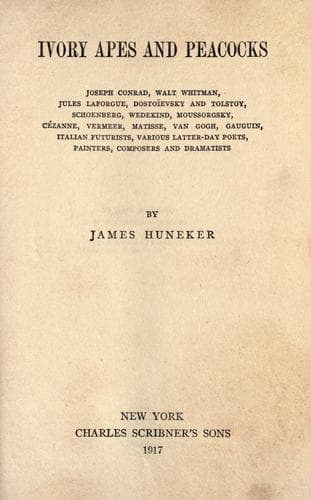
Art; Literature, Modern -- History and criticism; Music -- History and criticism
But Emma Bovary might come if you but ardently desired. And the
fascinating Anna Karenina. Or Becky Sharp with her sly graces. Perhaps
some of Dostoievsky's enigmatic, bewildering girls should be included
in the list, for they brim over with magnetism, very often a malicious
magnetism, and their glances are eloquent with suffering, haunt like
the eyes one sees in a gallery of old masters. I do not speak of
Sonia, but of the passionate Natasia Philipovna in The Idiot, or
Aglaya Epanchin, in the same powerful novel, or Paulina in The
Gambler. However, we cannot allow ourselves the luxury of so many
favourites, even if they are only made of paper and ink. I confess I
am an admirer of Emma Bovary. To the gifted young critics of to-day
the work, and its sharply etched characters, has become a mere
stalking horse for a new-fangled philosophy of Jules Gaultier, called
Bovarysme, but for me it will always be the portrait of that unhappy
girl with the pallid complexion, velvety dark eyes, luxuriant hair,
and languid charm. Anna Karenina is more aristocratic; above all, she
knew what happiness meant; its wing only brushed the cheek of Emma.
Her death is more lamentable than Anna's--one can well sympathise with
Flaubert's mental and physical condition after he had written that
appalling chapter describing the poisoning of Emma. No wonder he
thought he tasted arsenic, and couldn't sleep. Balzac, Dickens, and
Thackeray were thus affected by their own creations, yet Flaubert is
to this day called "impersonal," "cold," because he never made
concessions to sentimentalism, never told tales out of his workshop
for gaping indifferents.
As for Becky Sharp, that kittenish person seldom arouses in me much
curiosity. I agree with George Moore that Thackeray, in the interests
of mid-Victorian morality, suppressed many of her characteristics,
telling us too little of her amatory temperament. Possibly, Mr. Moore
may err, Becky may have had no "temperament," notwithstanding her
ability to twist men around her expressive digits. That she was
disagreeable when she set herself out to be I do not doubt; in fact,
she is the protagonist of a whole generation of disagreeable heroines
in English fiction. Bernard Shaw did not overlook her pertness and
malevolence, though all his girls are disagreeable, even--pardon the
paradox--his agreeable ones. But they are as portraiture far too
"papery," to borrow a word from painters' jargon, for my purpose.
They are not alive, they only are mouthpieces for the author's rather
old-time ideas.
Public-domain text, read in full here on John Shaqi.
Reviews
Reviews
No reviews yet
Be the first to share your thoughts on this work.
Elsewhere in the archive
Join the Discussion
Join the discussion
Sign in to leave a comment or review.
Sign InorCreate an account