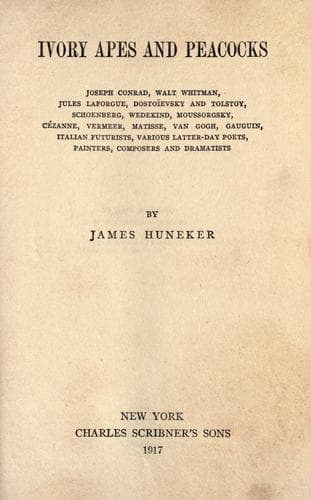
Art; Literature, Modern -- History and criticism; Music -- History and criticism
Tiring of art, Mildred takes up society, though she gets into a rather
dubious Paris set. A socialist deputy and his wife protect her and she
becomes a brilliant contributor--at least so she is made to
believe--to a publication in which is eventually sunk a lot of her
money. Her brother has warned her, but to no avail. At this juncture
the tale becomes slightly mysterious. Mildred flirts with the deputy,
his wife is apparently willing--having an interest elsewhere--and
suddenly the bottom drops out of the affair, and Mildred poorer, also
wiser, returns to her home in England. She has embraced the Roman
Catholic religion, but you do not feel she is sincerely pious. It is
one more gesture in her sterile career. At the end we find her trying
to evade the inevitable matrimony, for she is alone, her brother
dead, and she an heiress. Suspicious of her suitor's motives--it is
the same faithful Alfred--she wearily debates the situation: "Her
nerves were shattered, and life grows terribly distinct in the
insomnia of the hot summer night.... She threw herself over and over
in her burning bed, until at last her soul cried out in lucid misery:
'Give me a passion for god or man, but give me a passion. I cannot
live without one.'" For her "mad and sane are the same misprint." And
on this lyric note the book closes.
I believe if Hedda Gabler had hesitated and her father's pistol hadn't
been hard by, she would have recovered her poise and deceived her
husband. I believe that if Emma Bovary had escaped that snag of debt
she would have continued to fool Charles. And I believe Mildred Lawson
married at last and fooled herself into the belief that she had a
superior soul, misunderstood by the world and her husband. There is no
telling how vermicular are the wrigglings of mean souls. Mildred was a
snob, therefore mean of soul; and she was a cold snob, hence her
cruelty. That she was an eminently disagreeable girl I need hardly
emphasise. Nevertheless the young chaps found her dainty and her poor
girl friends, the artists, envied her pretty frocks. She had small
shell-like ears, ears that are danger-signals to experienced men.
Public-domain text, read in full here on John Shaqi.
Reviews
Reviews
No reviews yet
Be the first to share your thoughts on this work.
Elsewhere in the archive
Join the Discussion
Join the discussion
Sign in to leave a comment or review.
Sign InorCreate an account