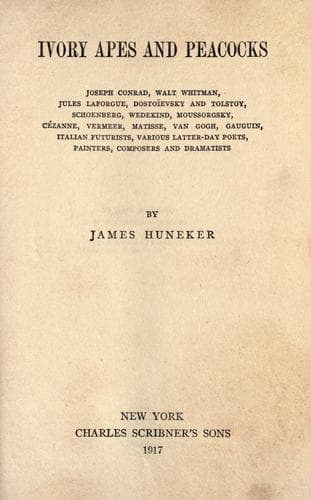
Art; Literature, Modern -- History and criticism; Music -- History and criticism
In Apex City Undine made up her mind to have her own way. She elopes
and marries a vulgar "hustler," but is speedily divorced. She is very
beautiful when she reaches New York. No emotional experience would
leave a blur on her radiant youth, because love for her is a
sensation, not a sentiment. By indirect and cumulative touches the
novelist evokes for us her image. Truly a lovely apparition, almost
mindless, with great sympathetic eyes and a sweet mouth. She exists,
does Undine. She is not the barren fruit of a satirical pen.
Foreigners, both men and women, puzzle over her freedom, chilliness,
and commercial horse-sense. She doesn't long intrigue their curiosity,
her brain is poorly furnished and conversation with her is not a fine
art. She is temperamental in the sense that she lives on her nerves;
without the hum and glitter of the opera, fashionable restaurants, or
dances she relapses into a sullen stupor, or rages wildly at the fate
that made her poor. She, too, like Hedda and Emma, lives in the
moment, a silly moth enamoured of a millionaire. Mildred Lawson is
positively intellectual in comparison, for she has a "go" at
picture-making, while the only pictures Undine cares for are those
produced by her own exquisitely plastic figure. No wonder Ralph
Marvell fell in love with her, or, rather, in love with his poetic
vision of her. He was, poor man, an idealist, and his fine porcelain
was soon cracked in contact with her brassy egotism.
He is of the old Washington Square stock, as antique--and as
honourable--as Methuselah. Undine soon tires of him; above all, tires
of his family and their old-fashioned social code. For her the rowdy
joys of Peter Van Degen and his set. The Odyssey of Undine is set
forth for us by an accomplished artist in prose. We see her in Italy,
blind to its natural beauties, blind to its art, unhappy till she gets
into the "hurrah" of St. Moritz. We follow her hence, note her
trailing her petty misery--boredom because she can't spend
extravagantly--through modish drawing-rooms; then a fresh hegira,
Europe, a divorce, the episode with Peter Van Degen and its profound
disillusionment (she has the courage to jump the main-travelled road
of convention for a brief term) and her remarriage. That, too, is a
failure, only because Undine so wills it. She has literally killed her
second husband because she wins from him by "legal" means their child,
and in the end she again marries her divorced husband, Elmer Moffatt,
now a magnate, a multimillionaire. She has at last followed the advice
of Mrs. Heeny, her adviser and masseuse. "Go steady, Undine, and
you'll get anywheres." We leave her in a blaze of rubies and glory at
her French chateau, and she isn't happy, for she has just learned
that, being divorced, she can never be an ambassadress, and that her
major detestation, the "Jim Driscolls," had been appointed to the
English court as ambassador from America. The novel ends with this
Public-domain text, read in full here on John Shaqi.
Reviews
Reviews
No reviews yet
Be the first to share your thoughts on this work.
Elsewhere in the archive