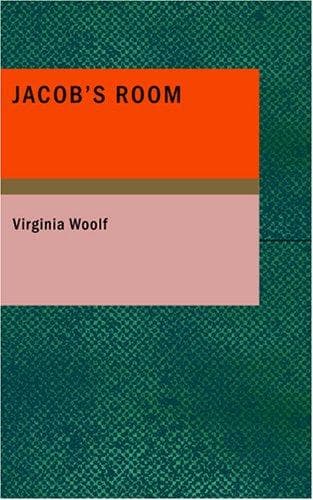
England -- Fiction; Experimental fiction; Psychological fiction; World War, 1914-1918 -- England -- Fiction; Young men -- Fiction
Pitt and Chatham, Burke and Gladstone looked from side to side with
fixed marble eyes and an air of immortal quiescence which perhaps the
living may have envied, the air being full of whistling and concussions,
as the procession with its banners passed down Whitehall. Moreover, some
were troubled with dyspepsia; one had at that very moment cracked the
glass of his spectacles; another spoke in Glasgow to-morrow; altogether
they looked too red, fat, pale or lean, to be dealing, as the marble
heads had dealt, with the course of history.
Timmy Durrant in his little room in the Admiralty, going to consult a
Blue book, stopped for a moment by the window and observed the placard
tied round the lamp-post.
Miss Thomas, one of the typists, said to her friend that if the Cabinet
was going to sit much longer she should miss her boy outside the Gaiety.
Timmy Durrant, returning with his Blue book under his arm, noticed a
little knot of people at the street corner; conglomerated as though one
of them knew something; and the others, pressing round him, looked up,
looked down, looked along the street. What was it that he knew?
Timothy, placing the Blue book before him, studied a paper sent round by
the Treasury for information. Mr. Crawley, his fellow-clerk, impaled a
letter on a skewer.
Jacob rose from his chair in Hyde Park, tore his ticket to pieces, and
walked away.
"Such a sunset," wrote Mrs. Flanders in her letter to Archer at
Singapore. "One couldn't make up one's mind to come indoors," she wrote.
"It seemed wicked to waste even a moment."
The long windows of Kensington Palace flushed fiery rose as Jacob walked
away; a flock of wild duck flew over the Serpentine; and the trees were
stood against the sky, blackly, magnificently.
"Jacob," wrote Mrs. Flanders, with the red light on her page, "is hard
at work after his delightful journey..."
"The Kaiser," the far-away voice remarked in Whitehall, "received me in
audience."
"Now I know that face--" said the Reverend Andrew Floyd, coming out of
Carter's shop in Piccadilly, "but who the dickens--?" and he watched
Jacob, turned round to look at him, but could not be sure--
"Oh, Jacob Flanders!" he remembered in a flash.
But he was so tall; so unconscious; such a fine young fellow.
"I gave him Byron's works," Andrew Floyd mused, and started forward, as
Jacob crossed the road; but hesitated, and let the moment pass, and lost
the opportunity.
Another procession, without banners, was blocking Long Acre. Carriages,
with dowagers in amethyst and gentlemen spotted with carnations,
intercepted cabs and motor-cars turned in the opposite direction, in
which jaded men in white waistcoats lolled, on their way home to
shrubberies and billiard-rooms in Putney and Wimbledon.
Two barrel-organs played by the kerb, and horses coming out of
Aldridge's with white labels on their buttocks straddled across the road
and were smartly jerked back.
Public-domain text, read in full here on John Shaqi.
Reviews
Reviews
No reviews yet
Be the first to share your thoughts on this work.
Elsewhere in the archive
Join the Discussion
Join the discussion
Sign in to leave a comment or review.
Sign InorCreate an account