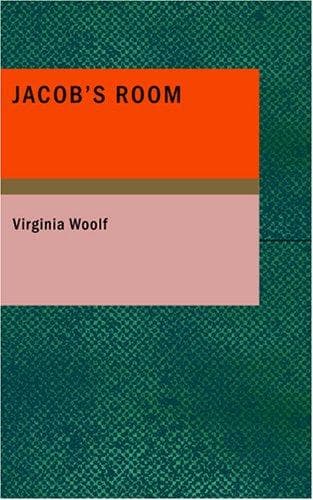
England -- Fiction; Experimental fiction; Psychological fiction; World War, 1914-1918 -- England -- Fiction; Young men -- Fiction
There was a little catastrophe. Miss Marchmont's pile overbalanced and
fell into Jacob's compartment. Such things happened to Miss Marchmont.
What was she seeking through millions of pages, in her old plush dress,
and her wig of claret-coloured hair, with her gems and her chilblains?
Sometimes one thing, sometimes another, to confirm her philosophy that
colour is sound--or, perhaps, it has something to do with music. She
could never quite say, though it was not for lack of trying. And she
could not ask you back to her room, for it was "not very clean, I'm
afraid," so she must catch you in the passage, or take a chair in Hyde
Park to explain her philosophy. The rhythm of the soul depends on
it--("how rude the little boys are!" she would say), and Mr. Asquith's
Irish policy, and Shakespeare comes in, "and Queen Alexandra most
graciously once acknowledged a copy of my pamphlet," she would say,
waving the little boys magnificently away. But she needs funds to
publish her book, for "publishers are capitalists--publishers are
cowards." And so, digging her elbow into her pile of books it fell over.
Jacob remained quite unmoved.
But Fraser, the atheist, on the other side, detesting plush, more than
once accosted with leaflets, shifted irritably. He abhorred
vagueness--the Christian religion, for example, and old Dean Parker's
pronouncements. Dean Parker wrote books and Fraser utterly destroyed
them by force of logic and left his children unbaptized--his wife did it
secretly in the washing basin--but Fraser ignored her, and went on
supporting blasphemers, distributing leaflets, getting up his facts in
the British Museum, always in the same check suit and fiery tie, but
pale, spotted, irritable. Indeed, what a work--to destroy religion!
Jacob transcribed a whole passage from Marlowe.
Miss Julia Hedge, the feminist, waited for her books. They did not come.
She wetted her pen. She looked about her. Her eye was caught by the
final letters in Lord Macaulay's name. And she read them all round the
dome--the names of great men which remind us--"Oh damn," said Julia
Hedge, "why didn't they leave room for an Eliot or a Bronte?"
Unfortunate Julia! wetting her pen in bitterness, and leaving her shoe
laces untied. When her books came she applied herself to her gigantic
labours, but perceived through one of the nerves of her exasperated
sensibility how composedly, unconcernedly, and with every consideration
the male readers applied themselves to theirs. That young man for
example. What had he got to do except copy out poetry? And she must
study statistics. There are more women than men. Yes; but if you let
women work as men work, they'll die off much quicker. They'll become
extinct. That was her argument. Death and gall and bitter dust were on
her pen-tip; and as the afternoon wore on, red had worked into her
cheek-bones and a light was in her eyes.
Public-domain text, read in full here on John Shaqi.
Reviews
Reviews
No reviews yet
Be the first to share your thoughts on this work.
Elsewhere in the archive
Join the Discussion
Join the discussion
Sign in to leave a comment or review.
Sign InorCreate an account