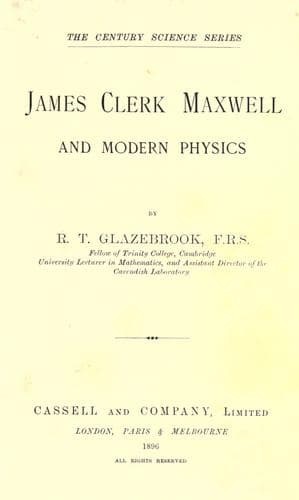
James Clerk Maxwell and Modern PhysicsGlazebrook, Richard
History
James Clerk Maxwell and Modern Physics
Glazebrook, Richard
Maxwell, James Clerk, 1831-1879; Physics -- History
Faraday, as we have seen, looked upon electrostatic and magnetic
induction as taking place along curved lines of force. He pictures
these lines as ropes of molecules starting from a charged conductor, or
a magnet, as the case may be, and acting on other bodies near. These
ropes of molecules tend to shorten, and at the same time to swell
outwards laterally. Thus the charged conductor tends to draw other
bodies to itself, there is a tension along the lines of force, while
at the same time each tube of molecules pushes its neighbours aside; a
pressure at right angles to the lines of force is combined with this
tension. Assuming for a moment this pressure and tension to exist, can
we devise a mechanism to account for it? Maxwell himself has likened
the lines of force to the fibres of a muscle. As the fibres contract,
causing the limb to which they are attached to move, they swell
outwards, and the muscle thickens.
Again, from another point of view, we might consider a line of force
as consisting of a string of small cells of some flexible material
each filled with fluid. If we then suppose this series of cells caused
to rotate rapidly about the direction of the line of force, the cells
will expand laterally and contract longitudinally; there will again be
tension along the lines of force and pressure at right angles to them.
It was this last idea, as we shall see shortly, of which Maxwell made
use--
“I propose now” [he writes (“On Physical Lines of Force,”
_Phil. Mag._, vol. xxi.)] “to examine magnetic phenomena from
a mechanical point of view, and to determine what tensions in,
or motions of, a medium are capable of producing the mechanical
phenomena observed. If by the same hypothesis we can connect
the phenomena of magnetic attraction with electro-magnetic
phenomena, and with those of induced currents, we shall have
found a theory which, if not true, can only be proved to be
erroneous by experiments, which will greatly enlarge our
knowledge of this part of physics.”
Lord Kelvin had in 1847 given a mechanical representation of electric,
magnetic and galvanic forces by means of the displacements of an
elastic solid in a state of strain. The angular displacement at each
point of the solid was taken as proportional to the magnetic force, and
from this the relation between the various other electric quantities
and the motion of the solid was developed. But Lord Kelvin did not
attempt to explain the origin of the observed forces by the effects due
to these strains, but merely made use of the mathematical analogy to
assist the imagination in the study of both.
Public-domain text, read in full here on John Shaqi.
Reviews
Reviews
No reviews yet
Be the first to share your thoughts on this work.
Elsewhere in the archive
Join the Discussion
Join the discussion
Sign in to leave a comment or review.
Sign InorCreate an account