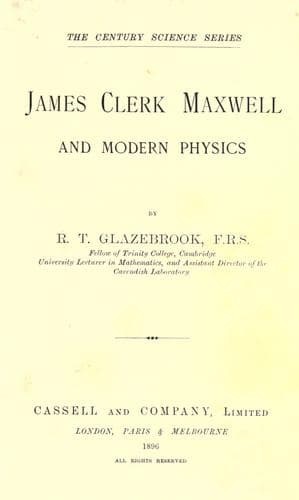
James Clerk Maxwell and Modern PhysicsGlazebrook, Richard
History
James Clerk Maxwell and Modern Physics
Glazebrook, Richard
Maxwell, James Clerk, 1831-1879; Physics -- History
“I think we have good evidence for the opinion that some
phenomenon of rotation is going on in the magnetic field, that
this rotation is performed by a great number of very small
portions of matter, each rotating on its own axis, this axis
being parallel to the direction of the magnetic force, and that
the rotations of these different vortices are made to depend on
one another by means of some kind of mechanism connecting them.
“The attempt which I then made to imagine a working model of
this mechanism must be taken for no more than it really is,
a demonstration that mechanism may be imagined capable of
producing a connection mechanically equivalent to the actual
connection of the parts of the electro-magnetic field. The
problem of determining the mechanism required to establish a
given species of connection between the motions of the parts of
a system always admits of an infinite number of solutions. Of
these, some may be more clumsy or more complex than others, but
all must satisfy the conditions of mechanism in general.
“The following results of the theory, however, are of higher
value:--
“(1) Magnetic force is the effect of the centrifugal force of
the vortices.
“(2) Electro-magnetic induction of currents is the effect of
the forces called into play when the velocity of the vortices
is changing.
“(3) Electromotive force arises from the stress on the
connecting mechanism.
“(4) Electric displacement arises from the elastic yielding of
the connecting mechanism.”
In studying this part of Maxwell’s work, it must clearly be remembered
that he did not look upon the ether as a series of cog-wheels with
idle wheels between, or anything of the kind. He devised a mechanical
model of such cogs and idle wheels, the properties of which would in
some respects closely resemble those of the ether; from this model he
deduced, among other things, the important fact that electric waves
would travel outwards with the velocity of light. Other such models
have been devised since his time to illustrate the same laws. Prof.
Fitzgerald has actually constructed one of wheels connected together by
elastic bands, which shows clearly the kind of processes which Maxwell
supposed to go on in a dielectric when under electric force. Professor
Lodge, in his book, “Modern Views of Electricity,” has very fully
developed a somewhat different arrangement of cog-wheels to attain the
same result.
Maxwell’s predictions as to the propagation of electric waves have
in recent days received their full verification in the brilliant
experiments of Hertz and his followers; it remains for us, before
dealing with these, to trace their final development in his hands.
Public-domain text, read in full here on John Shaqi.
Reviews
Reviews
No reviews yet
Be the first to share your thoughts on this work.
Elsewhere in the archive
Join the Discussion
Join the discussion
Sign in to leave a comment or review.
Sign InorCreate an account