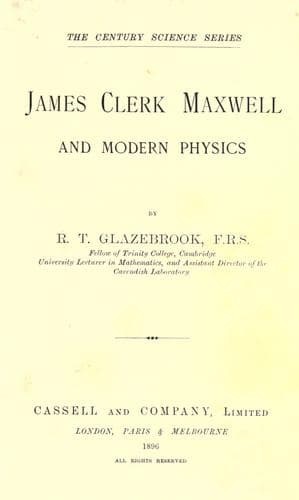
James Clerk Maxwell and Modern PhysicsGlazebrook, Richard
History
James Clerk Maxwell and Modern Physics
Glazebrook, Richard
Maxwell, James Clerk, 1831-1879; Physics -- History
We have obtained above three fundamental relations--(i) that between
electric force and electric current in a conductor; (ii) that between
electric force and electric displacement in a dielectric; (iii) that
between magnetic force and the current which gives rise to it. And
we have seen that an electric current--_i.e._ in a dielectric the
variation of the strength of an electric field of force--gives rise
to magnetic force. Now, magnetic force acting on a medium produces
“magnetic displacement,” or magnetic induction, as it is called. In
all media except iron, nickel, cobalt, and a few other substances, the
magnetic induction is proportional to the magnetic force, and the ratio
between the magnetic induction produced by a given force and the force
is found to be very nearly the same for all such media. This ratio is
known as the permeability, and is generally denoted by the symbol μ.
A relation reciprocal to that given in (iii) above might be
anticipated, and was, in fact, discovered by Faraday. Changes in a
field of magnetic induction give rise to electric force, and hence to
displacement currents in a dielectric or to conduction currents in a
conductor. In considering the relation between these changes and the
electric force, it is simplest at first not to deal with magnetic
matter such as iron, nickel, or cobalt; and then we may say that (iv)
the work which at any instant would be done in carrying a unit quantity
of electricity round a closed circuit in a magnetic field against the
electric forces due to the field is equal to the rate at which the
total magnetic induction which threads the circuit is being decreased.
This law, summing up Faraday’s experiments on electro-magnetic
induction, gives a fourth principle, leading to a fourth series of
equations connecting together the electric and magnetic quantities
involved.
The equations deduced from the above four principles, together with the
condition implied in the continuity of an electric current, constitute
Maxwell’s equations of the electro-magnetic field.
If we are dealing only with a dielectric medium, the reciprocal
relation between the third and fourth principle may be made more clear
by the following statement:--
(A) The work done at any moment in carrying a unit quantity of
magnetism round a closed circuit in a field in which electric
displacement is varying, is equal to the rate of change of the total
electric displacement through the circuit multiplied by 4 π.[62]
(B) The work done at any moment in carrying a unit quantity of
electricity round a circuit in a field in which the magnetic induction
is varying, is equal to the rate of change of the total magnetic
induction through the circuit.
From these two principles, combined with the laws connecting electric
force and displacement, magnetic force and induction, and with the
condition of continuity, Maxwell obtained his equations of the field.
Public-domain text, read in full here on John Shaqi.
Reviews
Reviews
No reviews yet
Be the first to share your thoughts on this work.
Elsewhere in the archive
Join the Discussion
Join the discussion
Sign in to leave a comment or review.
Sign InorCreate an account