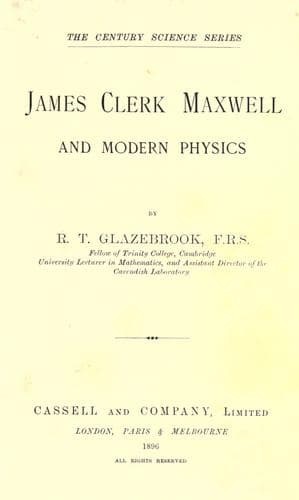
James Clerk Maxwell and Modern PhysicsGlazebrook, Richard
History
James Clerk Maxwell and Modern Physics
Glazebrook, Richard
Maxwell, James Clerk, 1831-1879; Physics -- History
In order to determine the force which is acting on any part of the
machine we must find its momentum, and then calculate the rate at
which this momentum is being changed. This rate of change will give us
the force. The method of calculation which it is necessary to employ
was first given by Lagrange, and afterwards developed, with some
modifications, by Hamilton. It is usually referred to as Hamilton’s
principle; when the equations in the original form are used they are
known as Lagrange’s equations.
Now Maxwell showed how these methods of calculation could be applied
to the electro-magnetic field. The energy of a dynamical system is
partly kinetic, partly potential. Maxwell supposes that the magnetic
energy of the field is kinetic energy, the electric energy potential.
When the kinetic energy of a system is known, the momentum of any
part of the system can be calculated by recognised processes. Thus if
we consider a circuit in an electro-magnetic field we can calculate
the energy of the field, and hence obtain the momentum corresponding
to this circuit. If we deal with a simple case in which the conducting
circuits are fixed in position, and only the current in each circuit is
allowed to vary, the rate of change of momentum corresponding to any
circuit will give the force in that circuit. The momentum in question
is electric momentum, and the force is electric force. Now we have
already seen that the electric force at any point of a conducting
circuit is given by the rate of change of the vector potential in the
direction considered. Hence we are led to identify the vector potential
with the electric momentum of our dynamical system; and, referring to
the original definition of vector potential, we see that the electric
momentum of a circuit is measured by the number of lines of magnetic
induction which are interlinked with it.
Again, the kinetic energy of a dynamical system can be expressed in
terms of the squares and products of the velocities of its several
parts. It can also be expressed by multiplying the velocity of each
driving-point by the momentum corresponding to that driving-point, and
taking half the sum of the products. Suppose, now, we are dealing with
a system consisting of a number of wire circuits in which currents are
running, and let us suppose that we may represent the current in each
wire as the velocity of a driving-point in our dynamical system. We can
also express in terms of these currents the electric momentum of each
wire circuit; let this be done, and let half the sum of the products of
the corresponding velocities and momenta be formed.
Public-domain text, read in full here on John Shaqi.
Reviews
Reviews
No reviews yet
Be the first to share your thoughts on this work.
Elsewhere in the archive
Join the Discussion
Join the discussion
Sign in to leave a comment or review.
Sign InorCreate an account