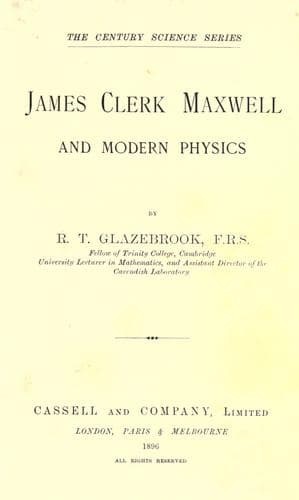
James Clerk Maxwell and Modern PhysicsGlazebrook, Richard
History
James Clerk Maxwell and Modern Physics
Glazebrook, Richard
Maxwell, James Clerk, 1831-1879; Physics -- History
Something such as this, it appears to me, is Maxwell’s theory of
electricity as applied to electrostatics. It is not necessary, in order
to understand it, to know what change in the ether constitutes electric
displacement, or what is an electric charge, though, of course, such
knowledge would render our views more definite, and would make the
theory a mechanical one.
When we turn to magnetism and electro-magnetism, Maxwell’s theory
develops itself naturally. Experiment proves that magnetic induction is
connected with the rate of change of electric displacement, according
to the laws already given. If, then, we knew the nature of the change
to which the name “electric displacement” has been given, the nature
of magnetic induction would be known. The difficulties in the way of
any mechanical explanation are, it is true, very great; assuming,
however, that some mechanical conception of “electric displacement”
is possible, Maxwell’s theory gives a consistent account of the other
phenomena of electro-magnetism.
Again, we have, it is true, an electro-magnetic theory of light, but
we do not know the nature of the change in the ether which affects
our eyes with the sensation of light. Is it the same as electric
displacement, or as magnetic induction, or since, when electric
displacement is varying, magnetic induction always accompanies it, is
the sensation of light due to the combined effect of the two?
These questions remain unanswered. It may be that light is neither
electric displacement nor magnetic induction, but some quite different
periodic change of structure of the ether, which travels through the
ether at the same rate as these quantities, and obeys many of the same
laws.
In this respect there is a material difference between the ordinary
theory of light and the electro-magnetic theory. The former is a
mechanical theory; it starts from the assumption that the periodic
change which constitutes light is the ordinary linear displacement of a
medium--the ether--having certain mechanical properties, and from those
properties it deduces the laws of optics with more or less success.
Lord Kelvin, in his labile ether, has devised a medium which could
exist and which has the necessary mechanical properties. The periodic
linear displacements of the labile ether would obey the laws of
light, and from the fundamental hypotheses of the theory, a mechanical
explanation, reasonably satisfactory in its main features, can be given
of most purely optical phenomena. The relations between light and
electricity, or light and magnetism, are not, however, touched by this
theory; indeed, they cannot be touched without making some assumption
as to what electric displacement is.
Public-domain text, read in full here on John Shaqi.
Reviews
Reviews
No reviews yet
Be the first to share your thoughts on this work.
Elsewhere in the archive
Join the Discussion
Join the discussion
Sign in to leave a comment or review.
Sign InorCreate an account