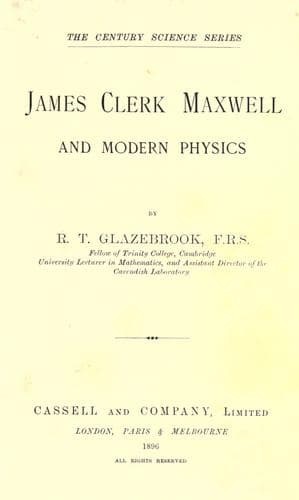
James Clerk Maxwell and Modern PhysicsGlazebrook, Richard
History
James Clerk Maxwell and Modern Physics
Glazebrook, Richard
Maxwell, James Clerk, 1831-1879; Physics -- History
But a gas consists of an indefinite number of molecules. Now it is
impossible to deal with each molecule individually, to trace its
history and follow its path. In order, therefore, to avoid this
difficulty Maxwell introduced the statistical method of dealing with
such problems, and this introduction is the first great step in
molecular theory with which his name is connected.
He was led to this method by his investigation into the theory of
Saturn’s rings, which had been completed in 1856, and in which he
had shown that the conditions of stability required the supposition
that the rings are composed of an indefinite number of free particles
revolving round the planet, with velocities depending on their
distances from the centre. These particles may either be arranged in
separate rings, or their motion may be such that they are continually
coming into collision with each other.
As an example of the statistical method, let us consider a crowd
of people moving along a street. Taken as a whole the crowd moves
steadily forwards. Any individual in the crowd, however, is jostled
backwards and forwards and from side to side; if a line were drawn
across the street we should find people crossing it in both directions.
In a considerable interval more people would cross it, going in the
direction in which the crowd is moving, than in the other, and the
velocity of the crowd might be estimated by counting the number which
crossed the line in a given interval. This velocity so found would
differ greatly from the velocity of any individual, which might have
any value within limits, and which is continually changing. If we knew
the velocity of each individual and the number of individuals we could
calculate the average velocity, and this would agree with the value
found by counting the resultant number of people who cross the line in
a given interval.
Again, the people in the crowd will naturally fall into groups
according to their velocities. At any moment there will be a certain
number of people whose velocities are all practically equal, or, to be
more accurate, do not differ among themselves by more than some small
quantity. The number of people at any moment in each of these groups
will be very different. The number in any group, which has a velocity
not differing greatly from the mean velocity of the whole, will be
large; comparatively few will have either a very large or a very small
velocity.
Again, at any moment, individuals are changing from one group to
another; a man is brought to a stop by some obstruction, and his
velocity is considerably altered--he passes from one group to a
different one; but while this is so, if the mean velocity remains
constant, and the size of the crowd be very great, the number of people
at any moment in a given group remains unchanged. People pass from that
group into others, but during any interval the same number pass back
again into that group.
Public-domain text, read in full here on John Shaqi.
Reviews
Reviews
No reviews yet
Be the first to share your thoughts on this work.
Elsewhere in the archive
Join the Discussion
Join the discussion
Sign in to leave a comment or review.
Sign InorCreate an account