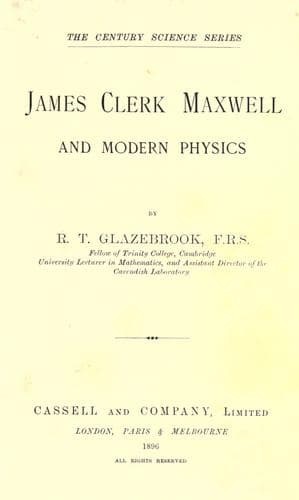
James Clerk Maxwell and Modern PhysicsGlazebrook, Richard
History
James Clerk Maxwell and Modern Physics
Glazebrook, Richard
Maxwell, James Clerk, 1831-1879; Physics -- History
“We have all acquired the mathematical conception of these
attractions. We can reason about them and determine their
appropriate forms or formulæ. These formulæ have a distinct
mathematical significance, and their results are found to be
in accordance with natural phenomena. There is no formula
in applied mathematics more consistent with Nature than the
formula of attractions, and no theory better established in
the minds of men than that of the action of bodies on one
another at a distance. The laws of the conduction of heat in
uniform media appear at first sight among the most different in
their physical relations from those relating to attractions.
The quantities which enter into them are _temperature_, _flow
of heat_, _conductivity_. The word _force_ is foreign to the
subject. Yet we find that the mathematical laws of the uniform
motion of heat in homogeneous media are identical in form
with those of attractions varying inversely as the square of
the distance. We have only to substitute _source of heat_ for
_centre of attraction_, _flow of heat_ for _accelerating effect
of attraction_ at any point, and _temperature_ for _potential_,
and the solution of a problem in attractions is transformed
into that of a problem in heat.
“This analogy between the formulæ of heat and attraction was, I
believe, first pointed out by Professor William Thomson in the
_Cambridge Mathematical Journal_, Vol. III.
“Now the conduction of heat is supposed to proceed by an
action between contiguous parts of a medium, while the force
of attraction is a relation between distant bodies, and yet,
if we knew nothing more than is expressed in the mathematical
formulæ, there would be nothing to distinguish between the one
set of phenomena and the other.
“It is true that, if we introduce other considerations and
observe additional facts, the two subjects will assume very
different aspects, but the mathematical resemblance of some
of their laws will remain, and may still be made useful in
exciting appropriate mathematical ideas.
Public-domain text, read in full here on John Shaqi.
Reviews
Reviews
No reviews yet
Be the first to share your thoughts on this work.
Elsewhere in the archive
Join the Discussion
Join the discussion
Sign in to leave a comment or review.
Sign InorCreate an account