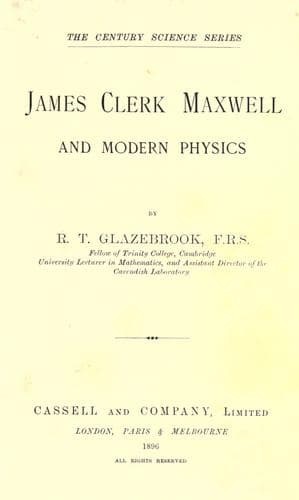
James Clerk Maxwell and Modern PhysicsGlazebrook, Richard
History
James Clerk Maxwell and Modern Physics
Glazebrook, Richard
Maxwell, James Clerk, 1831-1879; Physics -- History
Meanwhile, during the same period, various writers, Murphy, Plana,
Charles, Sturm, and Gauss, extended Poisson’s work on electrostatics,
treating the questions which arose as problems in the distribution of
an attracting fluid, attracting or repelling according to Newton’s law,
though here again the greatest advances were made by a self-taught
Nottingham shoemaker, George Green by name, in his paper “On the
Application of Mathematical Analysis to the Theories of Electricity and
Magnetism,” 1828.
Green’s researches, Lord Kelvin writes, “have led to the elementary
proposition which must constitute the legitimate foundation of every
perfect mathematical structure that is to be made from the materials
furnished by the experimental laws of Coulomb.”
Green, it may be remarked, was the inventor of the term Potential.
His essay, however, lay neglected from 1828, until Lord Kelvin called
attention to it in 1845. Meanwhile, some of its most important results
had been re-discovered by Gauss and Charles and Thomson himself.
Until about 1845, the experimental work on which these mathematical
researches in electrostatics were based was that of Coulomb. An
electrified body is supposed to have a charge of some imponderable
fluid “electricity.” Particles of electricity repel each other
according to a certain law, and the fluid distributes itself in
equilibrium over the surface of any charged conductor in accordance
with this law. There are on this theory two opposite kinds of electric
fluid, positive and negative, two charges of the same kind repel, two
charges of opposite kinds attract; the repulsion or attraction is
proportional to the product of the charges, and inversely proportional
to the square of the distance between them.
The action between two charges is action at a distance taking place
across the space which separates the two.
Faraday, in 1837, in the eleventh series of his “Experimental
Researches,” published his first paper on “Electrostatic Induction.”
He showed--as indeed Cavendish had proved long previously, though the
result remained unpublished--that the force between two charged bodies
will depend on the insulating medium which surrounds them, not merely
on their shape and position. Induction, as he expresses it, takes place
along curved lines, and is an action of contiguous particles; these
curved lines he calls the “lines of force.”
Discussing these researches in 1845, Lord Kelvin writes[60]:--
Public-domain text, read in full here on John Shaqi.
Reviews
Reviews
No reviews yet
Be the first to share your thoughts on this work.
Elsewhere in the archive
Join the Discussion
Join the discussion
Sign in to leave a comment or review.
Sign InorCreate an account