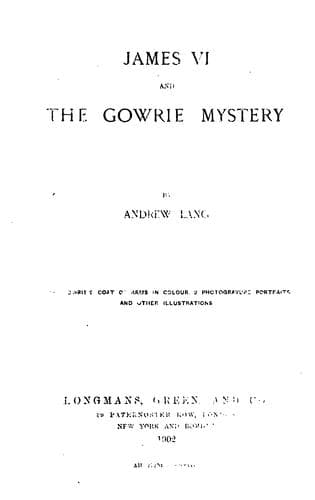
The frontispiece of this volume is copied from the design of the Earl of
Gowrie’s arms, in what is called ‘Workman’s MS.,’ at the Lyon’s office in
Edinburgh. The shield displays, within the royal treasure, the arms of
Ruthven in the first and fourth, those of Cameron and Halyburton in the
second and third quarters. The supporters are, dexter, a Goat; sinister,
a Ram; the crest is a Ram’s head. The motto is not given; it was DEID
SCHAW. The shield is blotted by transverse strokes of the pen, the whole
rude design having been made for the purpose of being thus scored out,
after Gowrie’s death, posthumous trial and forfeiture, in 1600.
On the left of the sinister supporter is an armed man, in the Gowrie
livery. His left hand grasps his sword-hilt, his right is raised to an
imperial crown, hanging above him in the air; from his lips issue the
words, TIBI SOLI, ‘for thee alone.’ Sir James Balfour Paul, Lyon,
informs me that he knows no other case of such additional supporter, or
whatever the figure ought to be called.
This figure does not occur on any known Ruthven seal. It is not on that
of the first Earl of Gowrie, affixed to a deed of February 1583–1584. It
is not on a seal used in 1597, by John, third Earl, given in Henry
Laing’s ‘Catalogue of Scottish Seals’ (vol. i. under ‘Ruthven’). But, in
Crawford’s ‘Peerage of Scotland’ (1716), p. 166, the writer gives the
arms of the third Earl (John, the victim of August 5, 1600). In place of
the traditional Scottish motto _Deid Schaw_, is the Latin translation,
_Facta Probant_. The writer says (Note C), ‘This from an authentic copy
of his arms, _richly illuminated in the year_ 1597, with his name and
titles, _viz._ “Joannes Ruthven, Comes de Gowry, Dominus de Ruthven,”
&c., in my hands.’
In 1597, as the archives of the Faculty of Law, in the University of
Padua, show, Gowrie was a student of Padua. It is also probable that, in
1597, he attained his majority. He certainly had his arms richly
illuminated, and he added to his ancestral bearings what Crawfurd
describes thus: ‘On the dexter a chivaleer, garnish’d with the Earl’s
coat of arms, _pointing with a sword upward to an imperial crown_, with
this device, TIBI SOLI.’
In Workman’s MS., the figure points to the crown with the open right
hand, and the left hand is on the sword-hilt. The illuminated copy of
1597, once in the possession of Crawfurd, must be the more authentic; the
figure _here_ points the sword at a crown, which is _Tibi Soli_, ‘For
thee’ (Gowrie?) ‘alone.’
Now on no known Ruthven seal, as we saw, does this figure appear, not
even on a seal of Gowrie himself, used in 1597. Thus it is perhaps not
too daring to suppose that Gowrie, when in Italy in 1597, added this
emblematic figure to his ancestral bearings. What does the figure
symbolise?
Public-domain text, read in full here on John Shaqi.
Reviews
Reviews
No reviews yet
Be the first to share your thoughts on this work.
Elsewhere in the archive
Join the Discussion
Join the discussion
Sign in to leave a comment or review.
Sign InorCreate an account