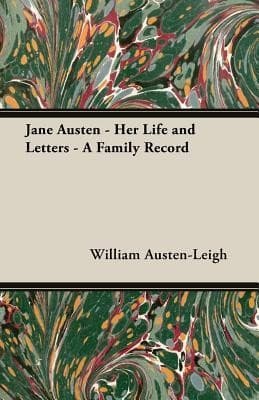
Jane Austen, Her Life and Letters: A Family RecordAusten-Leigh, William
General
Jane Austen, Her Life and Letters: A Family Record
Austen-Leigh, William
Austen, Jane, 1775-1817; Austen, Jane, 1775-1817 -- Family; Novelists, English -- 19th century -- Family relationships
Jane Austen was now between thirty-three and thirty-four years old. She
was absolutely free from any artistic self-consciousness, from any
eccentricity of either temper or manner. 'Hers was a mind well balanced
on a basis of good sense, sweetened by an affectionate heart, and
regulated by fixed principles; so that she was to be distinguished from
many other amiable and sensible women only by that peculiar genius which
shines out clearly . . . in her works.'[208] Her tastes were as normal as
her nature. She read English literature with eagerness, attracted by the
eighteenth-century perfection of style--and still more by the return to
nature in Cowper and the introduction of romance in Scott--but repelled
by coarseness, which she found even in the _Spectator_, and the presence
of which in Fielding made her rank him below Richardson. As for the
latter, 'Every circumstance narrated in _Sir Charles Grandison_, all
that was ever said or done in the "Cedar Parlour," was familiar to her;
and the wedding days of Lady L. and Lady G. were as well remembered as
if they had been living friends.' Her 'dear Dr. Johnson' was a constant
companion; and a younger friend was found in Crabbe, whom--as she used
to pretend--she was quite prepared to marry: not knowing at the time
whether he had a wife living or not.[209] As to her other tastes, she
greatly delighted in the beauties of nature, and no doubt would have
enjoyed foreign travel, had not that pleasure been quite out of her
reach. Her attitude to music, as an art, is more doubtful. She learnt to
play the piano in her youth, and after spending many years without an
instrument, took it up again on settling at Chawton; but she says
herself that she did this in order to be able to play country-dances for
her nephews and nieces; and when she goes to a concert she sometimes
remarks on her inability to enjoy it. A concert in Sydney Gardens,
however, was not perhaps likely to offer to the hearer many examples of
high art; and we have no means of knowing whether, if she had had a
chance of being introduced to classical music, it would have appealed to
her, as it sometimes does to intellectual people who have been
previously quite ignorant that they possessed any musical faculty. We
are told that she had a sweet voice, and sang with feeling. 'The
Soldier's Adieu' and 'The Yellow-haired Laddie' survive as the names of
two of her songs.
She was extraordinarily neat-handed in anything which she attempted. Her
hand-writing was both strong and pretty; her hemming and stitching, over
which she spent much time, 'might have put a sewing-machine to shame';
and at games, like spillikins or cup-and-ball, she was invincible.
Public-domain text, read in full here on John Shaqi.
Reviews
Reviews
No reviews yet
Be the first to share your thoughts on this work.
Elsewhere in the archive
Join the Discussion
Join the discussion
Sign in to leave a comment or review.
Sign InorCreate an account