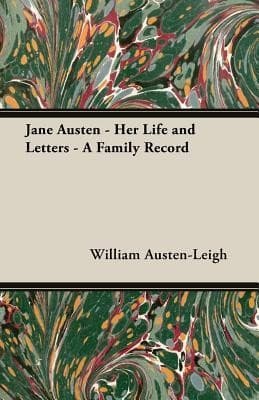
Jane Austen, Her Life and Letters: A Family RecordAusten-Leigh, William
General
Jane Austen, Her Life and Letters: A Family Record
Austen-Leigh, William
Austen, Jane, 1775-1817; Austen, Jane, 1775-1817 -- Family; Novelists, English -- 19th century -- Family relationships
himself. He goes nominally for three years, and a
Mr. Paget is to have the curacy of Godmersham; a
married man, with a very musical wife, which I
hope may make her a desirable acquaintance to
Fanny.
I thank you very warmly for your kind consent to
my application,[267] and the kind hint which
followed it. I was previously aware of what I
should be laying myself open to; but the truth is
that the secret has spread so far as to be
scarcely the shadow of a secret now, and that, I
believe, whenever the third appears, I shall not
even attempt to tell lies about it. I shall rather
try to make all the money than all the mystery I
can of it. People shall pay for their knowledge if
I can make them. Henry heard _P. and P._ warmly
praised in Scotland by Lady Robert Kerr and
another lady; and what does he do, in the warmth
of his brotherly vanity and love, but immediately
tell them who wrote it? A thing once set going in
that way--one knows how it spreads, and he, dear
creature, has set it going so much more than once.
I know it is all done from affection and
partiality, but at the same time let me here again
express to you and Mary my sense of the _superior_
kindness which you have shown on the occasion in
doing what I wished. I am trying to harden myself.
After all, what a trifle it is, in all its
bearings, to the really important points of one's
existence, even in this world.
Your very affectionate sister,
J. A.
There is to be a second edition of _S. and S._
Egerton advises it.
* * * * *
The last paragraph of this letter sets two things plainly before us: a
strong preference for remaining unknown if she could, and the invariable
sweetness of temper which forbade her to blame a brother whom she loved
because he had made such concealment impossible. That this acquiescence,
however, was not reached without a struggle the last few words of the
paragraph show.
Next follows a letter to Cassandra, dated Monday (October 11):--
We had our dinner party on Wednesday, with the
addition of Mrs. and Miss Milles. . . . Both mother
and daughter are much as I have always found them.
I like the mother--first, because she reminds me
of Mrs. Birch; and, secondly, because she is
cheerful and grateful for what she is at the age
of ninety and upwards. The day was pleasant
enough. I sat by Mr. Chisholme, and we talked away
at a great rate about nothing worth hearing.
* * * * *
Public-domain text, read in full here on John Shaqi.
Reviews
Reviews
No reviews yet
Be the first to share your thoughts on this work.
Elsewhere in the archive
Join the Discussion
Join the discussion
Sign in to leave a comment or review.
Sign InorCreate an account