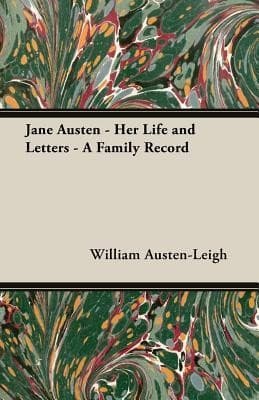
Jane Austen, Her Life and Letters: A Family RecordAusten-Leigh, William
General
Jane Austen, Her Life and Letters: A Family Record
Austen-Leigh, William
Austen, Jane, 1775-1817; Austen, Jane, 1775-1817 -- Family; Novelists, English -- 19th century -- Family relationships
All through this year and the early part of the next, _Emma_ (begun
January 1814, finished March 29, 1815) was assiduously worked at.
Although polished to the highest degree, it was more quickly composed
than any previous work and gave evidence of a practised hand. It was
also the most 'Austenish' of all her novels, carrying out most
completely her idea of what was fitted to her tastes and capacities. She
enjoyed having a heroine 'whom no one would like but herself,' and
working on 'three or four families in a country village.' _Emma_ appeals
therefore more exclusively than any of the others to an inner circle of
admirers: but such admirers may possibly place it at the head of her
compositions. There are no stirring incidents; there is no change of
scene. The heroine, whose society we enjoy throughout, never sleeps away
from home, and even there sees only so much company as an invalid father
can welcome. No character in the book is ill, no one is ruined, there
is no villain, and no paragon. On the other hand, the plot is admirably
contrived and never halts; while the mysteries--exclusively mysteries of
courtship and love--are excellently maintained. Emma never expresses any
opinion which is thoroughly sound, and seldom makes any forecast which
is not belied by the event, yet we always recognise her acuteness, and
she by degrees obtains our sympathy. The book also illustrates to the
highest degree the author's power of drawing humorous characters; Miss
Bates, Mr. Woodhouse, and Mrs. Elton in the first class, and Harriet
Smith in the second. And the humour is always essential to the
delineation of character--it is never an excrescence. It also depends
more on what is said than on any tricks of speech; there are no
catch-words, and every one speaks practically the same excellent
English. Besides this, _Emma_ also gives a very good instance of the
author's habit of building up her characters almost entirely without
formal description, and leaving analysis to her readers.
Her custom of following her creations outside the printed pages enables
us to say that the word swept aside unread by Jane Fairfax was 'pardon';
and that the Knightleys' exclusion from Donwell was ended by the death
of Mr. Woodhouse in two years' time. According to a less well-known
tradition, Jane Fairfax survived her elevation only nine or ten years.
Whether the John Knightleys afterwards settled at Hartfield, and whether
Frank Churchill married again, may be legitimate subjects for
speculation.[297]
Meanwhile, _Mansfield Park_ was selling well, and the idea of a second
edition began to be mooted. Writing from Chawton to her niece Fanny on
another subject (November 18, 1814), she tells her that the first
edition is all sold, and adds:--
Public-domain text, read in full here on John Shaqi.
Reviews
Reviews
No reviews yet
Be the first to share your thoughts on this work.
Elsewhere in the archive
Join the Discussion
Join the discussion
Sign in to leave a comment or review.
Sign InorCreate an account