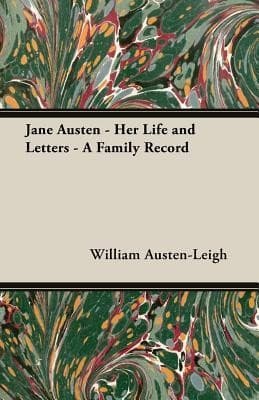
Jane Austen, Her Life and Letters: A Family RecordAusten-Leigh, William
General
Jane Austen, Her Life and Letters: A Family Record
Austen-Leigh, William
Austen, Jane, 1775-1817; Austen, Jane, 1775-1817 -- Family; Novelists, English -- 19th century -- Family relationships
We do not know how Mr. Jeffrey's involuntary
tribute of admiration was conveyed to the author,
but we are sure she must have valued it very
highly. It was not the first time she had
collected a miscellaneous set of opinions on her
work. The two following critiques on _Mansfield
Park_--apparently from two ladies of the same
family--will illustrate the sort of want of
comprehension from which the author had to suffer
when she got outside the limits of her own
immediate circle.
_Mrs. B._--Much pleased with it: particularly with
the character of Fanny as being so very natural.
Thought Lady Bertram like herself. Preferred it to
either of the others; but imagined _that_ might be
want of taste, as she did not understand wit.
_Mrs. Augusta B._ owned that she thought _S. and
S._ and _P. and P._ downright nonsense, but
expected to like _M. P._ better, and having
finished the first volume, flattered herself she
had got through the worst.
Meanwhile, the banking-house of Austen, Maunde, and Tilson, had closed
its doors; and on March 23, 1816, Henry Austen was declared a bankrupt:
the immediate cause of the collapse being the failure of an Alton bank
which the London firm had backed. No personal extravagance was charged
against Henry; but he had the unpleasant sensation of starting life over
again, and of having caused serious loss to several of his family,
especially his brother Edward and Mr. Leigh Perrot, who had gone
sureties for him on his appointment as Receiver-General for Oxfordshire.
Jane herself was fortunate in losing no more than thirteen pounds--a
portion of the profits of _Mansfield Park_.[314]
Henry Austen possessed an extraordinary elasticity of nature which made
a rebound from depression easy--indeed, almost inevitable--in his case.
He returned at once to his original intention of taking Orders, as if
the intervening military and banking career had been nothing more than
an interruption of his normal course. Nor was it merely perfunctory
performance of clerical duties to which he looked forward: he was in
earnest, and began by making use of his former classical knowledge to
take up a serious study of the New Testament in the original language.
He seems to have been in advance of his age in this respect; for when he
went to be examined by the Bishop, that dignitary, after asking him such
questions as he thought desirable, put his hand on a book which lay near
him on the table, and which happened to be a Greek Testament, and said:
'As for _this_ book, Mr. Austen, I dare say it is some years since
either you or I looked into it.'
Public-domain text, read in full here on John Shaqi.
Reviews
Reviews
No reviews yet
Be the first to share your thoughts on this work.
Elsewhere in the archive
Join the Discussion
Join the discussion
Sign in to leave a comment or review.
Sign InorCreate an account