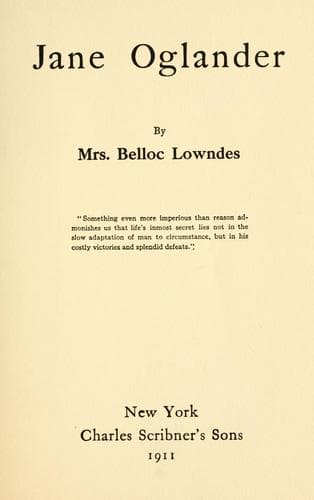
Country homes -- Fiction; England -- Social life and customs -- Fiction; Man-woman relationships -- Fiction
He remembered a long interview of this kind he had had with another
mother. That poor lady had received him surrounded by mementoes of a son
who had been a trusty and sure comrade to himself. He recalled the
photographs which had been brought out for his inspection, the floods of
tears which had punctuated each of his words. But Mrs. Kaye was far more
truly stricken than that other mother had been--Mrs. Kaye required no
photograph of her son to remind her of his face. She had not yet been
granted the relief of tears. Hers was evidently grief of a terrible, a
passionate intensity.
"It is good of you to say these things to me, General Lingard--and to
spare the time to come and see me," she said at last. "But I should not
have troubled you--I should not have presumed to trouble you, were it
not that I wish to consult you about what is to me a very important
matter."
He bowed his head gravely, and sat down in the shabby armchair to which
she rather imperiously motioned him.
"I am entirely at your service," he said quietly. No doubt she wanted
some message transmitted to the War Office.
"I have no one else to ask or to consult," she said in low, rapid tones.
"It is not a matter about which I desire to trouble my husband, and I am
glad to think that he knows, as yet, nothing of what I am going to say
to you. Whether he has to learn it or not will depend, General Lingard,
on your advice."
Lingard looked at her attentively. He was puzzled and rather disturbed
by her words.
"When they told my son he was not likely to live," she said, "he
persuaded the doctor to allow him to write a letter to me, his mother."
She stopped a moment, then went on steadily: "In it he made a certain
request. It is about that request I wish to consult you, General
Lingard. I wish to know whether you consider that I ought to be bound by
his wishes. My son desired that his Victoria Cross and one or two other
things which he greatly valued, and which we, his parents, naturally
value even more than he valued them, should be handed over, given by us
to--to a lady."
Lingard felt a sudden feeling of recoil from the woman who sat opposite
to him, watching for his answer. Then it was jealousy, pathetic but
rather ignoble jealousy, that was making poor Mrs. Kaye look as she
looked now--jealousy rather than grief....
There came the sound of a motor-car in the road which was above the
level of the rectory garden.
It stopped, and Lingard saw through the window Wantele jump out and
cross over to where Jane Oglander was walking up and down.
They spoke together for some moments, and Lingard felt a great
lightening of his heart. Wantele must be telling Jane the awful thing
which had happened, and he, Lingard, would be spared the dreadful task.
Jane came up close to the car. Lingard could not see the expression on
her face. At last, or so it seemed to him, they both got in under the
hood.
So Jane, breaking her promise to wait for him, had gone on to the house?
Public-domain text, read in full here on John Shaqi.
Reviews
Reviews
No reviews yet
Be the first to share your thoughts on this work.
Elsewhere in the archive
Join the Discussion
Join the discussion
Sign in to leave a comment or review.
Sign InorCreate an account