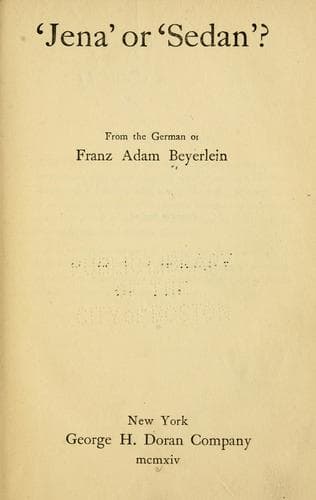
German fiction -- Translations into English; Germany. Heer -- Fiction
No wonder that the period of military service was extremely favourable
to the spread of social-democracy! Such sensational object-lessons were
not necessary; the circumstances of every-day life all pointed towards
socialism.
Wolf understood the part that Weise played in the battery. It was
always the same. Each batch of recruits was a mixture of men from towns
and men from the country. The city-bred, even if fewer in number,
immediately established an ascendancy over the country yokels. They
were quicker-witted, and their town bringing-up had developed their
intelligence more. And just because of this they adapted themselves
more easily to the requirements of military service, so that they often
made better soldiers than the country recruits with their slower
comprehension. Most of them were entirely unaware that they were
socialistic agitators; they quite unconsciously imparted to their
fellow-soldiers ideas that to them appeared self-evident, but that for
the others meant an upheaval of their whole way of thinking.
What was the use of searching every hole and corner of the barracks at
regular intervals for socialistic literature? They could confiscate red
rosettes and pamphlets; but how could they control transient,
intangible thoughts?
On Sundays the camp was as quiet as it was full of life on
week-days. The boundary-lines beyond which the men were not allowed to
pass without leave, were drawn round a considerable area. Within it
were three large villages; and on Sundays their taverns were thronged
by soldiers quartered in the camp. The enterprising innkeepers had made
ample provision for such crowds of visitors. They had erected wooden
platforms in the open air where dancing went on without intermission,
regimental bands supplying the music; and the amount of beer consumed
in one Sunday was greater than that drunk by the entire village the
whole winter through. Of course there were strong patrols set to keep
order at the dancing-platforms and licensed houses. As there were too
few partners for the soldiers quarrels were of constant occurrence, and
were seldom amicably settled; a brawl was the usual result, and at
times a regular fight.
Public-domain text, read in full here on John Shaqi.
Reviews
Reviews
No reviews yet
Be the first to share your thoughts on this work.
Elsewhere in the archive
Join the Discussion
Join the discussion
Sign in to leave a comment or review.
Sign InorCreate an account