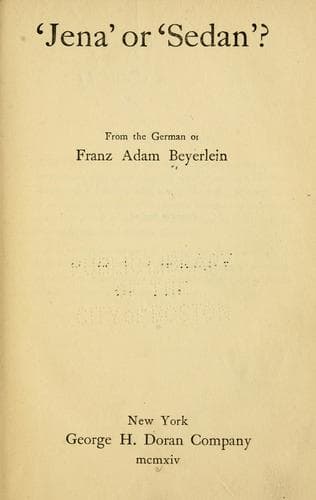
German fiction -- Translations into English; Germany. Heer -- Fiction
In her little sitting-room she sank limply into a chair. The windows
were wide open; she heard the rippling of the brook, and the insects
humming and buzzing in the big willow. At last she roused herself. She
must be certain if Trautvetter was right in his suspicion, and that
would need cunning. Her plan was soon made; it was very simple: she
need only behave as if she had been following her husband's hint, then
he would have to declare himself.
"Henke," she began that evening, "Trautvetter has made a proposal
to-day. As soon as he has finished his service he is going to buy a
place in the country, far away from here, and he wants me to keep house
for him. If you agree, then you shall have a hundred marks a month."
Henke was silent for a time; he was in some doubt what he should say to
this. Lisbeth was so queer and cold, almost uncanny; but on the other
hand she did not seem to be the least annoyed.
In a tone of would-be resignation he said at last: "Well, Lisbeth, if
you don't love me any more, if you think it's for your happiness, and
you like to leave me----" he stopped.
His wife was suddenly standing before him, deathly pale. She shook her
trembling clasped hands in his face, and spat contemptuously on the
boards in front of him. Then she fled from the room.
He looked after her stupefied.
"So she's gone!" he muttered. Well, it was no use being too tragic over
it. Either Lisbeth would be reasonable again, or----he was free of her.
There was a third possibility.
Countess Miramara had assured him that he could make an enormous
fortune if he would go on the stage as a cornet-player. To-morrow she
was going off to Bohemia. Suppose he were to join her? He did not
trouble himself about desertion: he had got his papers all right, and
desertion was not a crime for which one could be extradited. Austria
was a big place and a merry; so the countess asserted. And there was
Hungary too.
Really that would be the best thing to do.
Next day Henke was over the border. He had already converted all his
property into gold, and only took his trumpet with him. In place of his
artilleryman's coat he wore a gorgeous fancy uniform, which showed off
to the best advantage the excellences of his person. Evening after
evening he performed his most admired pieces.
And he became a favourite with all the ladies.
Frau Lisbeth, however, obtained the dissolution of her marriage on the
ground of malicious desertion.
At first she thought of furnishing a little shop in the town and
setting up a laundry; but Trautvetter begged her rather to go into
service for a time.
"Why?" asked she.
He found some difficulty in answering her. At last he came out with:
"I am very fond of you, Frau Lisbeth; and if you could make up your
mind to it I should like to ask you if you would have me."
Lisbeth smiled a little, and then said, "You may ask me that now!"
Her voice sounded honest and friendly.
Trautvetter took her hand in his and said: "Then that's all right!"
Public-domain text, read in full here on John Shaqi.
Reviews
Reviews
No reviews yet
Be the first to share your thoughts on this work.
Elsewhere in the archive
Join the Discussion
Join the discussion
Sign in to leave a comment or review.
Sign InorCreate an account