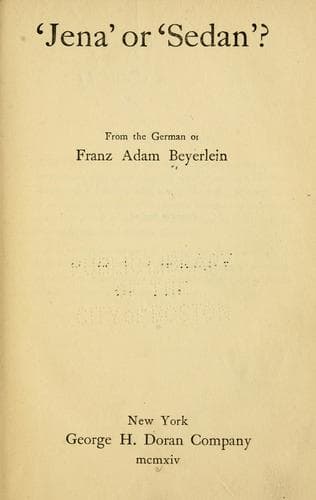
German fiction -- Translations into English; Germany. Heer -- Fiction
There seemed to him no doubt that the French field-artillery with its
anti-recoil construction had gained a great advantage over all other
armies; an advantage which could only be prejudiced if the utility of
the invention were proved on the field of battle to be less than was
expected. Up to the present time the French gun-carriage had only been
tested on a small scale in peace man[oe]uvres, and it had not been
absolutely demonstrated that its construction would stand the
continuous high pressure of a campaign. He was now absorbed in a scheme
for simplifying and strengthening the anti-recoil attachments in such a
way that they would keep in working order under the severest test. And
at the same time he had been directing his attention to the steel
shields used in the French field-artillery for the protection of the
men who served the guns. German military authorities were for the most
part opposed to the introduction of this method of protection; but the
shield seemed to him very worthy of adoption. In the battles of the
future the percentage of probable losses must be computed quite
mathematically; and it would be a great advantage if, by virtue of the
shield, a large number of the combatants could be considered safe.
The opponents of the measure gave it as their opinion that the men
would shirk quitting the protection of the shield; or that, at any
rate, they would take aim so hurriedly that their accuracy must
necessarily suffer. Well, one might equally well argue that the
infantry would refuse to leave their trenches. The other objection was
more convincing: shooting would become too difficult if this steel
shield were associated with the anti-recoil construction. It was a
question of mobility; therefore Güntz set to work to find out some
method of lightening the gun. Why should the gun-carriage be loaded
with such a large quantity of ammunition as was customary--more,
probably, than would ever be needed? He was constructing the model of a
carriage in which the quantity of ammunition carried was to be
diminished by one-third; so that the extra weight of the anti-recoil
construction and the steel shield should be more than counterbalanced.
When he was in Berlin he had gone into the details of his invention
with the head of a large Rhenish gun-foundry. This man proposed that
Güntz should send in his resignation and enter the service of the firm
at a handsome salary. Güntz at that time was not prepared to decide in
the matter; but at the close of the interview the manager had said:
"Who knows? perhaps we shall see each other again."
Had the man been right?
In any case, Güntz felt strong enough to make his own way through life.
The servant took his horse from him at the garden gate.
"Well, did it go off all right?" asked Kläre.
Public-domain text, read in full here on John Shaqi.
Reviews
Reviews
No reviews yet
Be the first to share your thoughts on this work.
Elsewhere in the archive
Join the Discussion
Join the discussion
Sign in to leave a comment or review.
Sign InorCreate an account