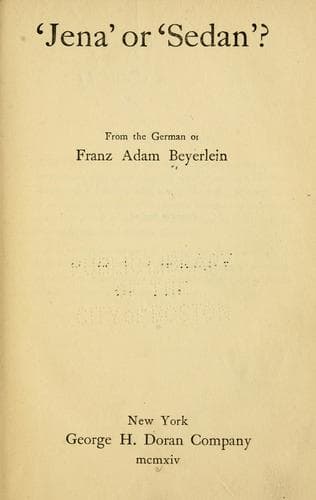
German fiction -- Translations into English; Germany. Heer -- Fiction
The evening before there had been a small _fête_, to which the captain
and the two subalterns had invited him and all the non-commissioned
officers of the battery. Then in the morning, in the presence of the
officers, including the colonel, and before all the men of the
regiment, the good-service cross, which the king had granted him, had
been handed him by the commanding officer; he had also received
permission to wear his old uniform at any patriotic festivities.
The colonel had spoken of him warmly as a pattern soldier, and had
concluded with a cheer for the emperor and the king. Then the
sergeant-major had requested that he, on his side, might be allowed to
say a few words; and with a voice which failed many times he led a
cheer for the beloved regiment, and especially for the splendid sixth
battery. Afterwards handsome presents were given him: from Wegstetten
and the two lieutenants a beautiful gold watch; from Major Schrader a
heavy gold chain for it; from the non-commissioned officers an album
with views of the town and the barracks, and with photographic groups
of officers, non-commissioned officers, men, and horses. Finally, the
commanding officer presented to him that service sabre which he had
worn for ten long years, to be now his own private property.
He had only been able to thank them by a silent grasp of the hand, for
fear that if he spoke he would begin to cry like a girl. Afterwards he
had also said farewell to all the men. So now he was ready and could
go.
It was about half an hour before the time for the afternoon drill. As
Schumann entered the parade-ground he heard a voice shout from the
steps: "The sergeant-major is going!" And in a moment all came running
towards him, the drivers and gunners, old stagers and raw recruits, the
entire battery crowding round to shake hands with him once more.
Again the sergeant-major had to clench his teeth; he passed silently
along, shaking the hands that were stretched out to him.
Suddenly he stopped in astonishment, thinking he must be mistaken. But
no, Wolf was there too--Wolf, the social-democrat, whose whole
existence as a soldier was a cynical mask, the revolutionist who was
only waiting for the moment when, free from the green uniform, he might
preach his faith again! And he, Schumann, had never been at any pains
to conceal what he thought of such disgraceful opinions.
Wolf had not exactly run up, but had come with the rake over his
shoulder with which he had been raking the riding-ground, and was at
any rate associating himself with the others.
"What, you too, Wolf?" Schumann involuntarily exclaimed.
"Yes, sir," answered the soldier. "You never were hard on any-one. You
were always just."
Public-domain text, read in full here on John Shaqi.
Reviews
Reviews
No reviews yet
Be the first to share your thoughts on this work.
Join the Discussion
Join the discussion
Sign in to leave a comment or review.
Sign InorCreate an account