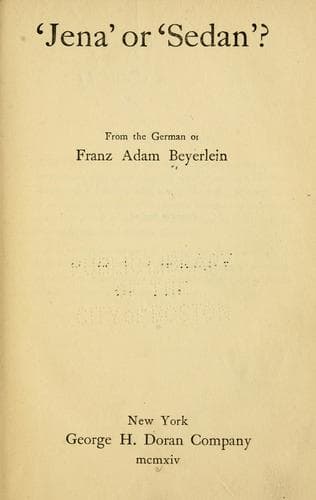
German fiction -- Translations into English; Germany. Heer -- Fiction
Güntz rose from his chair. He took a few turns up and down the room to
work off the stiffness, and grumbled on: "Done? To me? Nothing, of
course. But she's hysterical out and out. That's it, hysterical!"
Kläre warmly took up the defence of the accused woman. "You may be
right," she said, "but there's a reason for it."
"Certainly, certainly," answered Güntz. "Her husband is--forgive the
coarse expression, Kläre--a regular hog. But an hysterical woman is an
utter horror to me."
"I can only feel sorry for Frau von Gropphusen."
"And so do I. But I don't want her to hang on to you."
"She does not hang on to me," answered his wife simply.
But at this moment a subdued wailing was heard, and Kläre instantly
hastened from the room.
The men, left alone, dropped into reflection. Neither spoke for a
while.
At last Reimers broke the silence.
"I think, Güntz, that you exaggerate a bit. Senseless and silly
prejudices are not only to be found in military circles. Anyhow,
there's no good in running your head against a brick wall."
"True," assented Güntz. "But if a dung-cart were driven right under my
nose, I should have to give it a shove."
He resumed his perambulations of the room, and lapsed for a while into
silence.
"Anyhow," he began again, smiling contentedly, "Frau Gropphusen may
come to Kläre for consolation if she likes to have her. I am sure my
wife is proof against the hysterical bacillus. Eh?"
Before Reimers could answer, Kläre returned, a little flushed. She bore
the baby on a pillow, rocking him in her arms.
Güntz answered his own question.
"Yes, yes, she's proof," he said.
Reimers was thoroughly happy in the Güntzes' society. The atmosphere of
security and candour in which they lived influenced him unawares; it
wrought as a useful antidote when his spirit was inclined to soar too
high into the realms of the unsubstantial. He was much delighted to
find that his friend shared his admiration for his honoured and beloved
Falkenhein. Indeed, in this matter, the dry and reserved man sometimes
outdid his young fellow-officer.
"There's a _man_!" he would say. "Head and heart, eyes and mouth in the
right places! A good fellow. In one word--a man!"
This word was the highest in Güntz's vocabulary. The opposite to it,
until his marriage, had been woman. After marriage he naturally
excepted Kläre.
How sick he was of the way people went on in Berlin! He could hardly
speak too strongly about the weaknesses of certain officers.
Reimers did not hold it necessary to be absolutely blind to the faults
of one's superiors and comrades; still, he thought that his friend went
a bit too far in his strictures, and he did not conceal his opinion.
Public-domain text, read in full here on John Shaqi.
Reviews
Reviews
No reviews yet
Be the first to share your thoughts on this work.
Elsewhere in the archive
Join the Discussion
Join the discussion
Sign in to leave a comment or review.
Sign InorCreate an account