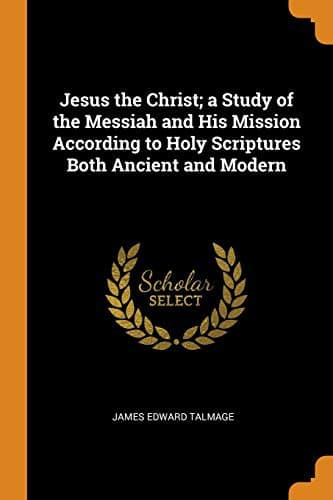
Jesus the Christ: A Study of the Messiah and His Mission According to Holy; Scriptures Both Ancient and ModernTalmage, James E. (James Edward)
Religion
Jesus the Christ: A Study of the Messiah and His Mission According to Holy; Scriptures Both Ancient and Modern
Talmage, James E. (James Edward)
Christian biography -- Palestine; Jesus Christ -- Biography; Jesus Christ -- Mormon interpretations
Realizing that he had utterly failed in his attempt to induce Jesus to
use His inherent power for personal service, and to trust in Himself
rather than rely upon the Father's providence, Satan went to the other
extreme and tempted Jesus to wantonly throw Himself upon the Father's
protection.[298] Jesus was standing upon one of the high parts of the
temple, a pinnacle or battlement, overlooking the spacious courts, when
the devil said unto Him: "If thou be the Son of God, cast thyself down:
for it is written, He shall give his angels charge concerning thee: and
in their hands they shall bear thee up, lest at any time thou dash thy
foot against a stone." Again appears the implication of doubt.[299] _If_
Jesus was in fact the Son of God, could He not trust His Father to save
Him, and particularly so as it was written[300] that angels would guard
Him and bear Him up? Christ's reply to the tempter in the wilderness had
embodied a scriptural citation, and this He had introduced with the
impressive formula common to expounders of sacred writ--"It is written."
In the second attempt, the devil tried to support his suggestion by
scripture, and employed a similar expression--"for it is written." Our
Lord met and answered the devil's quotation with another, saying: "It is
written again, Thou shalt not tempt the Lord thy God."[301]
Beside the provocation to sin by wantonly placing Himself in danger, so
that the Father's love might be manifested in a miraculous rescue, or by
refusing so to challenge the Father's interposition demonstrate that He
doubted His status as the Beloved Son, there lurked an appeal to the
human side of Christ's nature, in thought of the fame which an
astounding exploit, such as that of leaping from the dizzy height of the
temple turrets and alighting unhurt, would surely bring. We cannot
resist the thought, though we be not justified in saying that any such
had even momentary place in the Savior's mind, that to act upon Satan's
suggestion, provided of course the outcome proved to be such as he had
indicated, would have been to insure public recognition of Jesus as a
Being superior to mortals. It would have been a sign and a wonder
indeed, the fame of which would have spread as fire in the dry grass;
and all Jewry would have been aflame with excitement and interest in the
Christ.
Public-domain text, read in full here on John Shaqi.
Reviews
Reviews
No reviews yet
Be the first to share your thoughts on this work.
Elsewhere in the archive
Join the Discussion
Join the discussion
Sign in to leave a comment or review.
Sign InorCreate an account