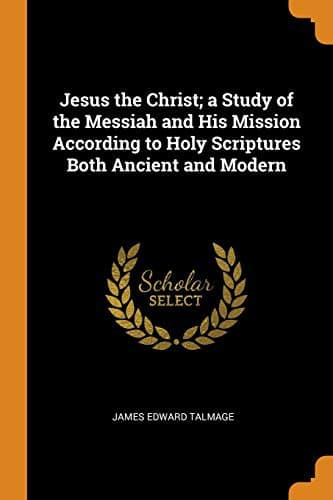
Jesus the Christ: A Study of the Messiah and His Mission According to Holy; Scriptures Both Ancient and ModernTalmage, James E. (James Edward)
Religion
Jesus the Christ: A Study of the Messiah and His Mission According to Holy; Scriptures Both Ancient and Modern
Talmage, James E. (James Edward)
Christian biography -- Palestine; Jesus Christ -- Biography; Jesus Christ -- Mormon interpretations
Few events in the evangelical history of Jesus of Nazareth have given
rise to more discussion, fanciful theory, and barren speculation, than
have the temptations. All such surmizes we may with propriety ignore. To
any believer in the holy scriptures, the account of the temptations
therein given is sufficiently explicit to put beyond doubt or question
the essential facts; to the unbeliever neither the Christ nor His
triumph appeals. What shall it profit us to speculate as to whether
Satan appeared to Jesus in visible form, or was present only as an
unseen spirit; whether he spoke in audible voice, or aroused in the mind
of his intended victim the thoughts later expressed by the written
lines; whether the three temptations occurred in immediate sequence or
were experienced at longer intervals? With safety we may reject all
theories of myth or parable in the scriptural account, and accept the
record as it stands; and with equal assurance may we affirm that the
temptations were real, and that the trials to which our Lord was put
constituted an actual and crucial test. To believe otherwise, one must
regard the scriptures as but fiction.
A question deserving some attention in this connection is that of the
peccability or impeccability of Christ--the question as to whether He
was capable of sinning. Had there been no possibility of His yielding to
the lures of Satan, there would have been no real test in the
temptations, no genuine victory in the result. Our Lord was sinless yet
peccable; He had the capacity, the ability to sin had He willed so to
do. Had He been bereft of the faculty to sin, He would have been shorn
of His free agency; and it was to safeguard and insure the agency of man
that He had offered Himself, before the world was, as a redeeming
sacrifice. To say that He could not sin because He was the embodiment of
righteousness is no denial of His agency of choice between evil and
good. A thoroughly truthful man cannot culpably lie; nevertheless his
insurance against falsehood is not that of external compulsion, but of
internal restraint due to his cultivated companionship of the spirit of
truth. A really honest man will neither take nor covet his neighbor's
goods, indeed it may be said that he cannot steal; yet he is capable of
stealing should he so elect. His honesty is an armor against temptation;
but the coat of mail, the helmet, the breastplate, and the greaves, are
but an outward covering; the man within may be vulnerable if he can be
reached.
Public-domain text, read in full here on John Shaqi.
Reviews
Reviews
No reviews yet
Be the first to share your thoughts on this work.
Elsewhere in the archive
Join the Discussion
Join the discussion
Sign in to leave a comment or review.
Sign InorCreate an account