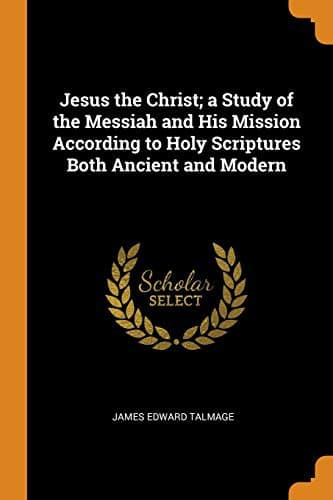
Jesus the Christ: A Study of the Messiah and His Mission According to Holy; Scriptures Both Ancient and ModernTalmage, James E. (James Edward)
Religion
Jesus the Christ: A Study of the Messiah and His Mission According to Holy; Scriptures Both Ancient and Modern
Talmage, James E. (James Edward)
Christian biography -- Palestine; Jesus Christ -- Biography; Jesus Christ -- Mormon interpretations
Concerning the mention of wild honey as food used by John, the author
last quoted says in a continuation of the same paragraph: "The wild bees
in Palestine are far more numerous than those kept in hives, and the
greater part of the honey sold in the southern districts is obtained
from wild swarms. Few countries, indeed, are better adapted for bees.
The dry climate, and the stunted but varied flora, consisting largely of
aromatic thymes, mints, and other similar plants, with crocuses in the
spring, are very favourable to them, while the dry recesses of the
limestone rocks everywhere afford them shelter and protection for their
combs. In the wilderness of Judea, bees are far more numerous than in
any other part of Palestine, and it is, to this day, part of the homely
diet of the Bedouins, who squeeze it from the combs and store it in
skins."
3. John's Inferiority to the Mightier One He Proclaimed.--"One mightier
than I cometh, the latchet of whose shoes I am not worthy to unloose"
(Luke 3:16), or "whose shoes I am not worthy to bear" (Matt. 3:11); this
was the way by which the Baptist declared his inferiority to the
Mightier One, who was to succeed and supersede him; and a more effective
illustration would be difficult to frame. To loosen the shoe latchet or
sandal thong, or to carry the shoes of another, "was a menial office
betokening great inferiority on the part of the person performing it."
(Smith's _Dict. of the Bible_.) A passage in the Talmud (_Tract.
Kidduschin xxii:2_) requires a disciple to do for his teacher whatever a
servant might be required to do for his master, except the loosing of
his sandal thong. Some teachers urged that a disciple should carry his
humility even to the extreme of carrying his master's shoes. The
humility of the Baptist, in view of the widespread interest his call
aroused, is impressive.
4. The Order in which the Temptations Were Presented.--But two of the
Gospel-writers specify the temptations to which Christ was subjected
immediately after His baptism; Mark merely mentions the fact that Jesus
was tempted. Matthew and Luke place first the temptation that Jesus
provide for Himself by miraculously creating bread; the sequence of the
later trials is not the same in the two records. The order followed in
the text is that of Matthew.
5. The Devil's "If."--Note the later taunting use of that diabolical
_if_ as the Christ hung upon the cross. The rulers of the Jews, mocking
the crucified Jesus in His agony said, "Let him save himself _if_ he be
the Christ." And the soldier, reading the inscription at the head of the
cross derided the dying God, saying: "_If_ thou be the king of the Jews,
save thyself." And yet again, the unrepentant malefactor by His side
cried but, "_If_ thou be Christ, save thyself and us." (Luke 23:35-39.)
How literally did those railers and mockers quote the very words of
their father the devil (see John 8:44). See further, page 658 herein.
Public-domain text, read in full here on John Shaqi.
Reviews
Reviews
No reviews yet
Be the first to share your thoughts on this work.
Elsewhere in the archive
Join the Discussion
Join the discussion
Sign in to leave a comment or review.
Sign InorCreate an account