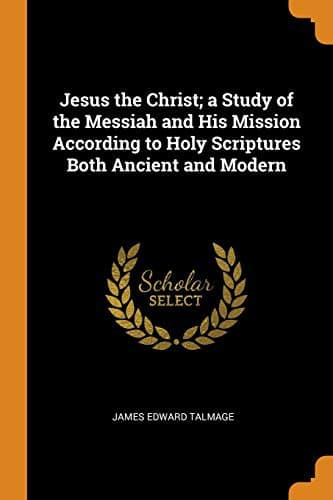
Jesus the Christ: A Study of the Messiah and His Mission According to Holy; Scriptures Both Ancient and ModernTalmage, James E. (James Edward)
Religion
Jesus the Christ: A Study of the Messiah and His Mission According to Holy; Scriptures Both Ancient and Modern
Talmage, James E. (James Edward)
Christian biography -- Palestine; Jesus Christ -- Biography; Jesus Christ -- Mormon interpretations
Nevertheless, His words to Mary at the marriage feast may have conveyed
a gentle reminder of her position as the mother of a Being superior to
herself; even as on that earlier occasion when she had found her Boy,
Jesus, in the temple, He had brought home to her the fact that her
jurisdiction over Him was not supreme. The manner in which she told Him
of the insufficiency of wine probably suggested an intimation that He
use His more than human power, and by such means supply the need. It was
not her function to direct or even to suggest the exercize of the power
inherent in Him as the Son of God; such had not been inherited from her.
"What have I to do with thee?" He asked; and added: "Mine hour is not
yet come." Here we find no disclaimer of the ability to do what she
apparently wanted Him to do, but the plain implication that He would act
only when the time was right for the purpose, and that He, not she, must
decide when that time had come. She understood His meaning, in part at
least, and contented herself by instructing the servants to do
whatsoever He directed. Here again is evidence of her position of
responsibility and domestic authority at the social gathering.
The time for His intervention soon arrived. There stood within the place
six water pots;[335] these He directed the servants to fill with water.
Then, without audible command or formula of invocation, as best we know,
He caused to be effected a transmutation within the pots, and when the
servants drew therefrom, it was wine, not water that issued. At a Jewish
social gathering, such as was this wedding festival, some one, usually a
relative of the host or hostess, or some other one worthy of the honor,
was made governor of the feast, or, as we say in this day, chairman, or
master of ceremonies. To this functionary the new wine was first served;
and he, calling the bridegroom, who was the real host, asked him why he
had reserved his choice wine till the last, when the usual custom was to
serve the best at the beginning, and the more ordinary later. The
immediate result of this, the first recorded of our Lord's miracles, is
thus tersely stated by the inspired evangelist: "This beginning of
miracles did Jesus in Cana of Galilee, and manifested forth his glory;
and his disciples believed on him."[336]
Public-domain text, read in full here on John Shaqi.
Reviews
Reviews
No reviews yet
Be the first to share your thoughts on this work.
Elsewhere in the archive
Join the Discussion
Join the discussion
Sign in to leave a comment or review.
Sign InorCreate an account