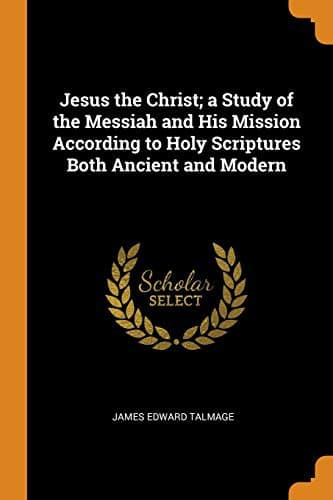
Jesus the Christ: A Study of the Messiah and His Mission According to Holy; Scriptures Both Ancient and ModernTalmage, James E. (James Edward)
Religion
Jesus the Christ: A Study of the Messiah and His Mission According to Holy; Scriptures Both Ancient and Modern
Talmage, James E. (James Edward)
Christian biography -- Palestine; Jesus Christ -- Biography; Jesus Christ -- Mormon interpretations
Miracles cannot be in contravention of natural law, but are wrought
through the operation of laws not universally or commonly recognized.
Gravitation is everywhere operative, but the local and special
application of other agencies may appear to nullify it--as by muscular
effort or mechanical impulse a stone is lifted from the ground, poised
aloft, or sent hurtling through space. At every stage of the process,
however, gravity is in full play, though its effect is modified by that
of other and locally superior energy. The human sense of the miraculous
wanes as comprehension of the operative process increases. Achievements
made possible by modern invention of telegraph and telephone with or
without wires, the transmutation of mechanical power into electricity
with its manifold present applications and yet future possibilities, the
development of the gasoline motor, the present accomplishments in aerial
navigation--these are no longer miracles in man's estimation, because
they are all in some degree understood, are controlled by human agency,
and, moreover, are continuous in their operation and not phenomenal. We
arbitrarily classify as miracles only such phenomena as are unusual,
special, transitory, and wrought by an agency beyond the power of man's
control.
In a broader sense, all nature is miracle. Man has learned that by
planting the seed of the grape in suitable soil, and by due cultivation,
he may conduce to the growth of what shall be a mature and fruitful
vine; but is there no miracle, even in the sense of inscrutable
processes, in that development? Is there less of real miracle in the
so-called natural course of plant development--the growth of root, stem,
leaves, and fruit, with the final elaboration of the rich nectar of the
vine--than there was in what appears supernatural in the transmutation
of water into wine at Cana?
In the contemplation of the miracles wrought by Christ, we must of
necessity recognize the operation of a power transcending our present
human understanding. In this field, science has not yet advanced far
enough to analyze and explain. To deny the actuality of miracles on the
ground that, because we cannot comprehend the means, the reported
results are fictitious, is to arrogate to the human mind the attribute
of omniscience, by implying that what man cannot comprehend cannot be,
and that therefore he is able to comprehend all that is. The miracles of
record in the Gospels are as fully supported by evidence as are many of
the historical events which call forth neither protest nor demand for
further proof. To the believer in the divinity of Christ, the miracles
are sufficiently attested; to the unbeliever they appear but as myths
and fables.[342]
To comprehend the works of Christ, one must know Him as the Son of God;
to the man who has not yet learned to know, to the honest soul who would
inquire after the Lord, the invitation is ready; let him "Come and see."
NOTES TO CHAPTER 11.
Public-domain text, read in full here on John Shaqi.
Reviews
Reviews
No reviews yet
Be the first to share your thoughts on this work.
Elsewhere in the archive
Join the Discussion
Join the discussion
Sign in to leave a comment or review.
Sign InorCreate an account