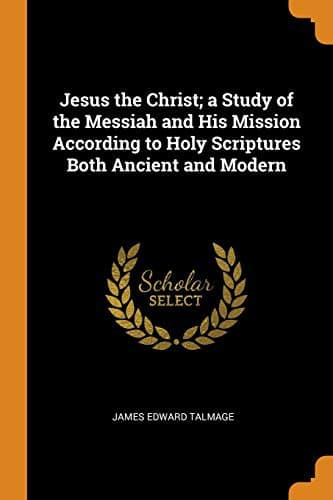
Jesus the Christ: A Study of the Messiah and His Mission According to Holy; Scriptures Both Ancient and ModernTalmage, James E. (James Edward)
Religion
Jesus the Christ: A Study of the Messiah and His Mission According to Holy; Scriptures Both Ancient and Modern
Talmage, James E. (James Edward)
Christian biography -- Palestine; Jesus Christ -- Biography; Jesus Christ -- Mormon interpretations
8. The Testimony of Miracles.--The Savior's promise in a former day
(Mark 16:17-18), as in the present dispensation (Doc. and Cov.
84:65-73), is definite, to the effect that specified gifts of the Spirit
are to follow the believer as signs of divine favor. The possession and
exercize of such gifts may be taken therefore as essential features of
the Church of Christ. Nevertheless we are not justified in regarding the
evidence of miracles as infallible testimony of authority from heaven;
on the other hand, the scriptures furnish abundant proof that spiritual
powers of the baser sort have wrought miracles, and will continue so to
do, to the deceiving of many who lack discernment. If miracles be
accepted as infallible evidence of godly power, the magicians of Egypt,
through the wonders which they accomplished in opposition to the
ordained plan for Israel's deliverance, have as good a claim to our
respect as has Moses (Exo. 7:11). John the Revelator saw in vision a
wicked power working miracles, and thereby deceiving many; doing great
wonders, even bringing fire from heaven (Rev. 13:11-18). Again, he saw
three unclean spirits, whom he knew to be "the spirits of devils working
miracles" (Rev. 16:13-14). Consider, in connection with this, the
prediction made by the Savior:--There shall arise false Christs, and
false prophets, and shall show great signs and wonders, insomuch that,
if it were possible, they shall deceive the very elect (Matt. 24:24).
The invalidity of miracles as a proof of righteousness is indicated in
an utterance of Jesus Christ regarding the events of the great
judgment:--"Many will say to me in that day, Lord, Lord, have we not
prophesied in thy name? and in thy name have cast out devils? and in thy
name done many wonderful works? And then will I profess unto them, I
never knew you; depart from me, ye that work iniquity" (Matt. 7:22-23).
The Jews, to whom these teachings were addressed, knew that wonders
could be wrought by evil powers; for they charged Christ with working
miracles by the authority of Beelzebub the prince of devils (Matt.
12:22-30; Mark 3:22; Luke 11:15).--From the author's _The Articles of
Faith_, xii:25, 26.
FOOTNOTES:
[309] Luke 3:4.
[310] John 1:21; compare Mal. 4:5. Note 1, end of chapter.
[311] Deut. 18:15, 18; see page 45 herein.
[312] John 1:22, 23; compare Isa. 40:3.
[313] John 1:25-27.
[314] John 1:29-31.
[315] John 1:32, 34; also verses 35, 36. Note 2, end of chapter.
[316] Note 3, end of chapter.
[317] John 1:35-51.
[318] Note 4, end of chapter.
[319] The name thus given was afterward confirmed, with accompaniments
of promise; Matt. 16:18.
[320] To the apostles the Lord said on a subsequent occasion: "Ye have
not chosen me, but I have chosen you" (John 15:16; see also 6:70).
[321] A favorite situation for rest, meditation, and study; 1 Kings
4:25; Micah 4:4.
[322] Acts 7:56; Rev. 1:13; 14:14.
[323] Job 25:6; Psalms 144:3; 146:3; see also 8:4 and compare Heb.
2:6-9.
Public-domain text, read in full here on John Shaqi.
Reviews
Reviews
No reviews yet
Be the first to share your thoughts on this work.
Elsewhere in the archive
Join the Discussion
Join the discussion
Sign in to leave a comment or review.
Sign InorCreate an account