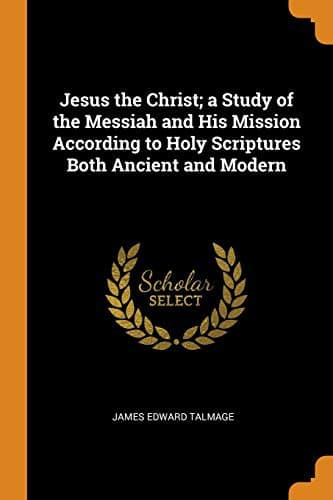
Jesus the Christ: A Study of the Messiah and His Mission According to Holy; Scriptures Both Ancient and ModernTalmage, James E. (James Edward)
Religion
Jesus the Christ: A Study of the Messiah and His Mission According to Holy; Scriptures Both Ancient and Modern
Talmage, James E. (James Edward)
Christian biography -- Palestine; Jesus Christ -- Biography; Jesus Christ -- Mormon interpretations
The synoptic Gospels,[346] which are primarily devoted to the labors of
Christ in Galilee, contain no mention of His attendance at the paschal
festival between His twelfth year and the time of His death; to John
alone are we indebted for the record of this visit at the beginning of
Christ's public ministry. It is not improbable that Jesus had been
present at other Passovers during the eighteen years over which the
evangelists pass in complete and reverent silence; but at any or all
such earlier visits, He, not being thirty years old, could not have
assumed the right or privilege of a teacher without contravening
established customs.[347] It is worth our attention to note that on
this, the first recorded appearance of Jesus in the temple subsequent to
His visit as a Boy, He should resume His "Father's business" where He
had before been engaged. It was in His Father's service that He had been
found in discussion with the doctors of the law,[348] and in His
Father's cause He was impelled to action on this later occasion.
The multitudinous and mixed attendance at the Passover celebration has
already received passing mention;[349] some of the unseemly customs that
prevailed are to be held in mind. The law of Moses had been supplemented
by a cumulative array of rules, and the rigidly enforced requirements as
to sacrifices and tribute had given rise to a system of sale and barter
within the sacred precincts of the House of the Lord. In the outer
courts were stalls of oxen, pens of sheep, cages of doves and pigeons;
and the ceremonial fitness of these sacrificial victims was cried aloud
by the sellers, and charged for in full measure. It was the custom also
to pay the yearly poll tribute of the sanctuary at this season--the
ransom offering required of every male in Israel, and amounting to half
a shekel[350] for each, irrespective of his relative poverty or wealth.
This was to be paid "after the shekel of the sanctuary," which
limitation, as rabbis had ruled, meant payment in temple coin. Ordinary
money, varieties of which bore effigies and inscriptions of heathen
import, was not acceptable, and as a result, money-changers plied a
thriving trade on the temple grounds.
Public-domain text, read in full here on John Shaqi.
Reviews
Reviews
No reviews yet
Be the first to share your thoughts on this work.
Elsewhere in the archive
Join the Discussion
Join the discussion
Sign in to leave a comment or review.
Sign InorCreate an account