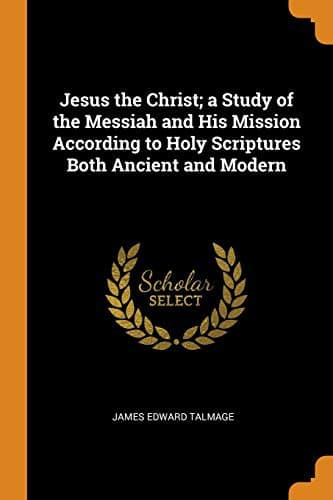
Jesus the Christ: A Study of the Messiah and His Mission According to Holy; Scriptures Both Ancient and ModernTalmage, James E. (James Edward)
Religion
Jesus the Christ: A Study of the Messiah and His Mission According to Holy; Scriptures Both Ancient and Modern
Talmage, James E. (James Edward)
Christian biography -- Palestine; Jesus Christ -- Biography; Jesus Christ -- Mormon interpretations
The shores of the
sea of Galilee as well as the lake itself were the scenes of many of the
most remarkable events recorded in the Gospels."
2. The Four Gospels.--All careful students of the New Testament must
have observed that the books of Matthew, Mark, and Luke, treat the
events of the Savior's sayings and doings in Galilee with greater
fulness than they accord to His work in Judea; the book or Gospel of
John, on the other hand, treats particularly the incidents of our Lord's
Judean ministry, without excluding, however, important events that
occurred in Galilee. In style of writing and method of treatment, the
authors of the first three Gospels (evangelists as they and John are
collectively styled in theologic literature) differ more markedly from
the author of the fourth Gospel than among themselves. The events
recorded by the first three can be more readily classified, collated, or
arranged, and in consequence the Gospels written by Matthew, Mark, and
Luke are now commonly known as the Synoptics, or Synoptic Gospels.
3. Thirty Years of Age.--According to Luke (3:23) Jesus was about thirty
years of age at the time of His baptism, and we find that soon
thereafter, He entered publicly upon the work of His ministry. The law
provided that at the age of thirty years the Levites were required to
enter upon their special service (Numb. 4:3). Clarke, _Bible
Commentary_, treating the passage in Luke 3:23, says: "This was the age
required by the law to which the priests must arrive before they could
be installed in their office." Jesus may possibly have had regard for
what had become a custom of the time, in waiting until He had attained
that age before entering publicly on the labors of a Teacher among the
people. Not being of Levitical descent He was not eligible to priestly
ordination in the Aaronic order, and therefore, certainly did not wait
for such before beginning His ministry. To have taught in public at an
earlier age would have been to arouse criticism, and objection, which
might have resulted in serious handicap or hindrance at the outset.
Public-domain text, read in full here on John Shaqi.
Reviews
Reviews
No reviews yet
Be the first to share your thoughts on this work.
Elsewhere in the archive
Join the Discussion
Join the discussion
Sign in to leave a comment or review.
Sign InorCreate an account